 Kalyan Chatterjee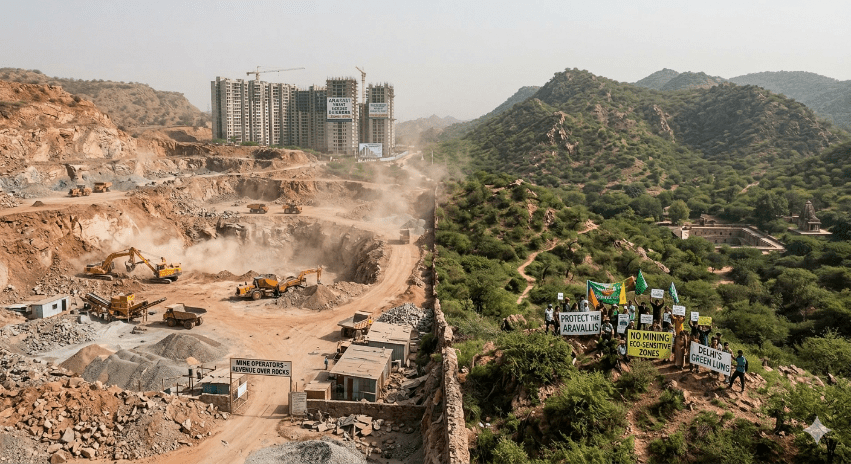
The latest controversy was sparked off in November 2025, when a government proposal to limit the definition of the range to only hills more than 100 metres high received the endorsement of the Supreme Court.
Environmentalists soon raised a clamour for the protection of the Aravalli and called the proposal a sell-out to the mining lobby. If this proposal was implemented, they said, more than 90 per cent of the range would no longer enjoy protection against indiscriminate mining. Mining that could destroy a crucial barrier holding back the western desert from the Gangetic Valley, besides being a repository of biodiversity and water resources. The Aravalli environment has already borne the brunt of the rapid urban expansion of the National Capital Region (NCR) that includes two townships of Gurgaon and Faridabad.
On the other hand, supporters of development policy argue that the rich mineral resources of the Aravalli Range must be extracted for development including the manufacture of electric vehicles to protect the environment. Rajasthan’s large deposits of zinc, copper, lead, gold, iron ore, limestone and lignite, besides other minor minerals used as building materials like granite, sandstone and masonry stone, have been enumerated by the state government in a note to the Central Empowered Committee (CEC) in February 2024, that is looking into the matter.
The state’s mineral policy (2024) plans to expand the mineral sector in a big way to more than double its share of the GSDP (gross state domestic product) by 2046-47. The state plans to expand the mining area from 2339 sq. km to 4000 sq. km. by 2047 which naturally will cover much of the Aravalli Range. The note provided details, “Mineral blocks in the Aravalli Hills in the state of Rajasthan which could not be auctioned due to … Supreme Court’s restriction on mining”. The CEC was constituted by the Supreme Court in May, 2002 to monitor implementation of the court’s orders on the environment and forests.
Why Narrowing the Aravalli Threatens More Than Hills:
The Supreme Court, however, was quick to respond to the fears of environmentalists and on December 29, 2025 it stayed its own November 20 order, directing a deeper study of the matter to make sure that environmental concerns were addressed. Though not as spectacular as the snow-covered Himalayas, environmentally speaking the Aravalli Range, one of the oldest mountain chains in the world plays an equally crucial role for large parts of northern India. Apart from mineral resources, the Aravalli Hills and Ranges also harbour rich biodiversity, with 22 wildlife sanctuaries, four tiger reserves, the Keoladeo National Park, along with wetlands like Sultanpur, Sambhar, Siliserh, and Asola Bhati and aquifers that recharge important river systems including the Chambal, Sabarmati, Luni, Mahi and Banas.
Aravalli at the Crossroads – A 40-Year Battle Over India’s Oldest Range:
In case of a clash between environment and development, the courts have spoken in favour of environment. The Supreme Court observed (MC Mehta case), “Life, public health and ecology have priority over unemployment and loss of revenue. … in case of doubt protection of environment would have precedence over economic interest.”
The development juggernaut has nevertheless rolled on and a seesaw battle for the past three-and-a-half decades, between those seeking to extract the mineral wealth on the Aravalli Hills and environmentalists who want to curtail mining activities to protect the crucial ecological services. Courts have intervened from time to time with landmark decisions in the matter on several occasions.
In a reaction to the November order, Dr. Rajendra Singh of the Tarun Bharat Sangh (TBS), which has played a central role in getting the Supreme Court to ban illegal mining in the Aravalli at Sariska Tiger Reserve in Alwar, gave a statement. He said, “It was not height alone that defined a mountain chain. A definition must include its basic elements, structure and biodiversity”. He added, “After reading the court order, I realised that the mountain range was facing a new threat under the guise of sustainable development. The government seems to be only looking after mining and industrial interests. They are not worried about India’s future”.
Giving details, Dr. Singh said, “Of the Aravalli landscape, 107,494 sq. km is below 20 metres in height, 12,081 sq km is between 20-40 metres, 5,009 sq km is between 40-60 metres, 2,656 sq km is between 60-80 metres and 1,594 sq km is between 80-100 metres. Only 1,048 sq km was above 100 metres (only 8.7 per cent of the total area). If only hills above 100 metres were protected, then more than 93 per cent of the Aravallis would be left out”.
Rajendra Singh pointed out, environmental systems were holistic and functioned in a continuous and integrated manner. They could not be separated into parts by legal boundaries that were mere administrative instruments. Categorisation of the Aravalli based on height is violation of its basic natural right.
He said, “The Aravalli must be viewed as an organic form in its entirety, not merely as an elevated geographical line with slopes. It silently lays the foundation of water quality, rain-cycle and soil stability of the entire northern India. It obstructs clouds from both the Bay of Bengal and the Arabian Sea to result in rainfall. In its layers are hidden not only the geological history but aquifers and water seeping through vertical faults, micro-organisms that hold the soil together and wide expanses of rocks that appear to be barren, but in fact form the backbone of water balance in the region. If these aspects are not included in any definition, then it limits the natural truth. Any definition should be run through scientists, environmentalists, local people and hydrologists. A definition that includes cultural aspects should be framed by a committee consisting of all the above and ecologists and legal experts. Merely changing the definition will not help in conservation”.
The Petition That Started It All – The Aravalli Mining Case:
The ball in the Aravalli mining case was set rolling in 1985 by environment lawyer M.C. Mehta through a PIL to check pollution from mining around the tourist resorts of Badkal Lake and Suraj Kund. However, it became a wider environmental issue in 1991 when TBS filed a PIL in the Supreme Court seeking a ban on illegal mining in the Sariska Tiger Reserve near Alwar. Sariska had previously been an exclusive hunting forest belonging to the erstwhile Alwar Princely State. But after independence it had been declared a ‘Game Reserve’ and notified as a protected forest in 1975 under the Rajasthan Forest Act (1953) and declared as a sanctuary under the Wildlife Protection Act (1972) in 1978-79. The 1200-sq km forest became the Sariska Tiger Reserve, part of the total 58 tiger reserves created across the country under ‘Project Tiger’.
These laws restricted mining that could impair environment and wildlife in the protected areas.
TBS alleged that despite the ban on mining in protected forests without the prior permission of the central government, the Rajasthan Government had in the late 1980s illegally issued about 400 mining leases to extract limestone and dolomite inside the protected area. The hills were blasted, drilled and chiselled to obtain marble which not only left deep scars on the landscape but also degraded the ecology and constituted a threat to wildlife. The mine-owners challenged the legal basis of the notification, as well as the maps of the protected forests.
The Supreme Court bench, consisting of Justices M.N. Venkatachaliah and B.P. Jeevan Reddy, rejected the contention of the mine-owners and came down heavily on the state government stating, “It was odd that the State Government while professing to protect the environment by these notifications should, at the same time, permit degradation of the environment by authorising mining operations in the protect ed area”.
The Court suspended mining in the protected areas, but in view of the ambiguity with respect to the precise boundaries of the protected areas, it appointed a five-member committee headed by a former High Court Judge M.L. Jain to demarcate the boundaries of the protected areas. Even now the mine-owners tried to scare away the TBS and even beat up Dr. Singh. They stopped after one miner was sent to jail for the assault.
In the meantime, in response to a remote sensing study that stated mining had created 22 large gaps in the Aravalli Hills, the central government came up with a notification in 1992, banning mining in forest areas in two districts (Gurgaon in Haryana and Alwar in Rajasthan) of the Aravalli Hills without prior permission. The notification made submission of an environment impact assessment (EIA) and an environment management plan (EMP) mandatory to obtain permission for mining.
Meanwhile, the Jain Committee identified 215 mines that were operating within the protected forests and another 47 were operating partly within the protected forest using maps provided by the forest and revenue departments of the Rajasthan Government. The committee recommended the immediate closure of the 215 mines and those parts of the 47 mines that were operating within the protected areas.
The Supreme Court accepted the recommendations of the Committee, ordering the immediate closure of the 215 mines within the protected forest area. Doubts about the maps of protected areas submitted by the Committee were rejected by the court saying that objections of mine-owners could not prevail over official maps and records.
The next big judgment of the Supreme Court came in October 2002. It banned mining activities in the entire Aravalli Range across Haryana and Rajasthan, after the discovery that despite the laws and notifications, mining continued in the Aravalli Hills, particularly in an area which was being reforested under a Japanese-aided project. In December, the court modified the order allowing mining in forest areas if prior permission had been obtained from the central government.
Most of the mines had failed to obtain environmental clearance or to submit EMPs. Mining pits of silica sand were turned into huge groundwater lakes and groundwater extracted. Huge amounts of overburden was seen in the area.
Since the entire Aravalli Hills had now been brough into focus, it became necessary to identify their extent. This was done for the first time in 2010, by the Forest Survey of India (FSI), which carried out an exercise for the delineation of the Aravalli Hills in Rajasthan following a Supreme Court order. The FSI used on 244 detailed 1:50,000 topographical maps of the Survey of India.
However, the disturbing discovery revealed that as many as 31 hills out of a sample 128 had vanished. This was found in an on-the-spot verification of a 5% sample out of a total of 2269 hills and hillocks in Alwar District. The Survey of India maps had been prepared in 1967-68. So, the hills had vanished in the 40 intervening years. This destruction amounted to a quarter of the sample and was blamed on rampant indiscriminate mining, as ironically pointed out by the CEC itself in a 2018 report. Describing the horrendous methods used by the ‘mining and crusher mafia’, CEC stated, “approximately 3,000 to 3,500 kg of explosive is used in one go and 4 inch bore holes are drilled to plant explosives to blast off hillocks and rocks in huge quantities”. Pointing out further it stated, “The extent of illegal mining was so severe that hillocks situated in several forest blocks of Haryana have almost vanished”.
The opening episode of this latest tussle began in January 2024, when the Supreme Court asked CEC to examine the issue of the classification of the Aravalli Hills, upon a submission by Rajasthan for a comprehensive direction by the court. In the report submitted by the CEC in October 2025, it recommended the adoption of hills ‘above 100 metres from the local relief’, as the definition of the Aravalli Range. This was the definition that was already being followed by Rajasthan since 2010.
But the question of the Aravalli, considered to be the backbone of India by some, as it protects northern India from the advance of the western desert, remains open. As of now it appears that environment activists have managed to halt the march of development at the cost of the environment. The ball is in the court of the Supreme Court which has only stayed its own earlier order, not quashed it.