 Dr. Bhashyam Kasturi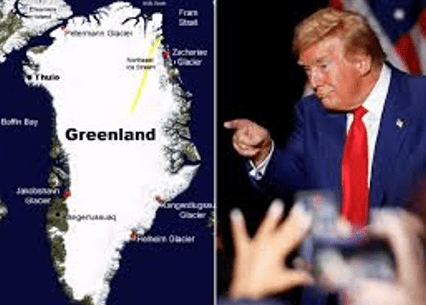
At the heart of the matter lies Trump’s apparent fixation on the Nobel Peace Prize—and his willingness to bend diplomacy to that pursuit. In a letter to Norway’s prime minister, Trump reportedly linked his desire to acquire Greenland for the United States to Norway’s failure to award him the Nobel, claiming credit for ending eight wars! This is, despite Norway’s PM Jonas Gahr Store has issued a statement that the prize is awarded by an independent committee and not by the government of Norway. Is Trump listening or is he infatuated by the Nobel Peace Prize?
One thing is certain; making Greenland a part of the US on the grounds of national security, will not get him a Nobel Peace Prize.
1951 Defence Treaty with Greenland
The fact is the US already has a 1951 treaty with Denmark and a base in Greenland, which can be used to expand existing infrastructure and military presence. Yet Trump wants to take over the island at the risk of breaking the Atlantic alliance with Europe and the North Atlantic Treaty Organization (NATO). So, what makes Trump think he can gain control over real estate on a whim and fancy by merely threatening the use of force? The Kingdom of Denmark has controlled Greenland since 1814. Countering Russia and China, access to natural resources and a keenness to add to his real estate business, lie at the heart of Trump’s call to make Greenland a part of the United States. All of these fit a pattern of Trump making preposterous claims over territory belonging to other countries, but with a certain crazy logic that transcends traditional thinking.
Strategic importance of Greenland
President Trump had first expressed an interest in taking over Greenland in 2019. With a population of around 56,000 people, Greenland is strategically important because of its proximity to the Arctic Circle and sits astride the major sea routes in and out of the Arctic. With Russia gradually opening the Northern Arctic Sea Route and inviting China to make greater use of the same, the US is concerned about a Russian and Chinese presence in the Atlantic Ocean via the Arctic route, in the near future. Greenland is home today to a single US military base, (though it had several during the Cold War) the primary objective being to have ballistic missile warning systems in place that forewarn the US of Russian missile launches in advances.
The roots of US presence in Greenland can be traced to the Second World War when Denmark’s US Ambassador Heinrik Kauffmann, signed a treaty (of his own accord) seeking American protection against a possible Nazi invasion. During the war, Germany had occupied Denmark. The pact was ratified by both the government and Parliament of Denmark at the end of the Second World War, but it was expected that it would be terminated thereafter. A few years later, with the cold war having set in, the US decided to stay on. Earlier in 1946, the US Secretary of State James F. Byrnes, had hinted at a possible purchase of Greenland by the US, much to the horror of the Danes.
The 1951 Defence Pact
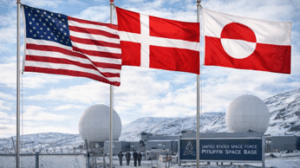
In 1951, both sides signed a treaty permitting the US to station troops in Greenland. Notably, the ‘Defence of Greenland’ pact grants the US the right to expand its military presence in Greenland. At the height of the Cold War, in Greenland’s north was the largest addition- the construction of Thule Air Base (now Pituffik Space Base), which housed more than 10,000 US troops, at one point in time. Therefore, the US still has an active treaty under which it can expand its presence whenever it wants. Interestingly, the text of the Treaty makes it clear that it was NATO which invited both the US, and Denmark to sign a pact over Greenland to enable NATO members, including the US to use Greenland as a base.
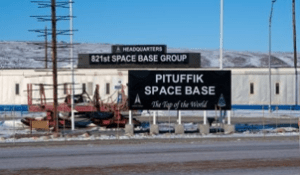
As the life of the US-Denmark 1951 Treaty is co-terminus with that of the North Atlantic Treaty, Article II clearly gives US enough leeway to expand its presence. This could be done by a diplomatic arrangement between the Kingdom of Denmark and the US. The point is that Trump is not interested in NATO anymore. He is focused on the defence of the US, but on his terms and not in alliance. He aims his own version of missile defence on Greenland, a kind of cold war defence system that would prevent Russian and Chinese missiles from reaching the US mainland. But wait, his more recent utterances speak of increased presence of Russian and Chinese warships in Arctic waters off the coast of Greenland. Does open-source intelligence support this assertion?
Trump’s claims about Russia and China

Denmark’s Joint Arctic Command chief Major General Soren Andersen recently stated that, the main task of the command in Greenland was on countering potential Russian activity, not defending against US military threats. Andersen told Reuters, “There were no Chinese or Russian ships near Greenland, though he added that a Russian research vessel was located 310 nautical miles away”. “That’s the closest one”, he said. Adding, “NATO allies maintain a good picture of the situation up here”. However, NATO knows that Russia is assessing how it can bolster its presence in the Arctic and use the route in its north, now available due to ice melt. Russia has also invited Chinese vessels, commercial, research and military, to use this route to circumvent the Suez/Panama route. Therefore, one can expect a greater Russian presence in the future. The Northern Sea Route offers a shorter sea route to Asia and Europe; however, challenges remain due to the weather conditions. In the long run, Russia would like to have greater control over the Arctic, both from a resource and transit point of view.
Assuming that Russia is not going to invade Greenland, immediately, and that Trump is aware that his actions over the island are likely to create a rift within NATO, such conditions would only suit Moscow. Even as diplomatic efforts continue, Trump’s administration is pushing hard because the President wants it to happen. What personal legacy does the US president want to leave by acquiring this piece of real estate?
Presently, with Russia focused on Ukraine, it appears that the US is losing interest in Kyiv. That combined with the Greenland proposal throwing a spanner in the NATO wheels, the US appears to be distancing itself from the Ukraine war, giving Moscow a further fillip in its action on the Ukraine front.
Presence of Rare Earths in Greenland
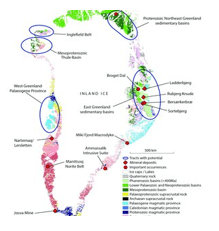
The importance of critical minerals to Greenland is well understood, but yet not fully exploited. Reuters reports from a survey in 2023 that revealed Greenland holds 25 out of 34 minerals classified as “critical raw materials” by the European Commission. These minerals include key materials for batteries, such as graphite and lithium, as well as rare earth elements used in electric vehicles and wind turbines. However, Greenland imposed a ban on oil and natural gas extraction in July 2021 due to environmental concerns. Consequently, Greenland’s economy remains overwhelmingly dependent on fishing, which accounts for the bulk of its exports. Denmark, meanwhile, underwrites nearly half of the island’s public budget. Any diversification—through the extraction and commercial use of Greenland’s natural resources—lies some distance in the future. Until then, the question remains: what, exactly, would Trump do?
Trump’s Diversion Tactics
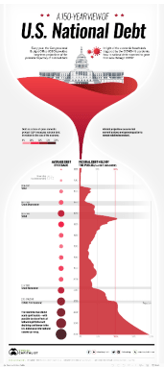

Trump’s external dramatics is underpinned by a serious debt crisis facing the US. The debt to GDP ratio was 124% in 2025 and according to official figures the average GDP for fiscal year 2025 was $30.36 Trillion, which was less than the US debt of $37.64 Trillion. Usually, a higher debt to GDP ratio indicates a government will have greater difficulty in repaying its debt. This combined with political pressure to release the entire Epstein files makes it easy for Trump to divert attention from domestic troubles by asserting himself over Venezuela and Greenland.
Conclusions
Taken as a whole, Trump’s proposal to make Greenland part of the United States appears less a strategic gambit than an exercise in personal aggrandizement. The move seems driven more by the pursuit of spectacle and legacy than by any serious effort to counter Russia or China in the Arctic.
A more credible strategy would lie elsewhere. Given the trajectory of Chinese naval expansion in both the Pacific and, increasingly, the Arctic, Washington would do better to focus its energies on the Indo-Pacific, while reinforcing Greenland through existing alliances, treaties, and defence arrangements. Such an approach would help ensure that the Northern Sea Route does not become a Russian monopoly—without upending the international order in the process.
Yet the Greenland episode points to a deeper and more troubling challenge facing Europe and the world under Trump’s leadership: a marked disdain for international rules and legal norms. Venezuela may be only the opening act in a broader vision of global affairs—one in which an ostensibly isolationist America proves, paradoxically, to be brazenly interventionist. Far from retreating, the deep state and the military-industrial complex appear as active as ever.
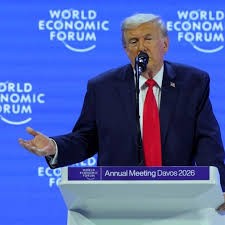
Recent diplomatic engagements—including the Danish foreign minister’s visit to Washington—suggest that Mr. Trump is unwilling, or unable, to translate rhetoric into policy. The fact that a lone Greenlander was once seen on television holding a placard reading “Buy Greenland,” or that some citizens favour independence, does not confer upon an American president the right to march in and claim the island. One is not arguing that such coercive action is impossible; Venezuela offers a cautionary example of how norms can be bent or ignored. But to what end—and at what cost? What, then, becomes of Europe?
The deeper damage lies elsewhere. Such manoeuvres further erode an already fragile international order, emboldening leaders like Xi Jinping and Vladimir Putin to test the limits of power and law. That, whatever the eventual outcome, is the real tragedy of the Greenland escapade.