 Dr. Bhashyam Kasturi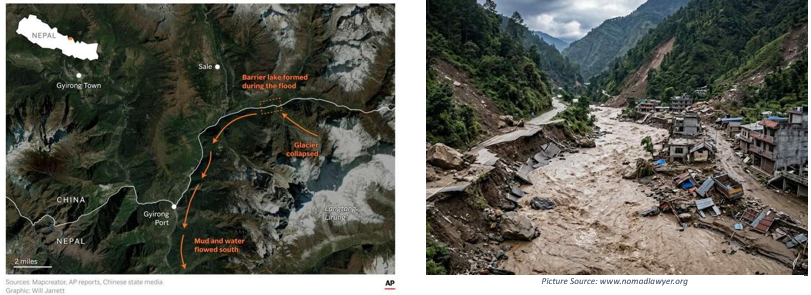
Glacier Collapse Triggers Catastrophe
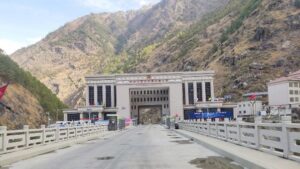
The glacier collapse triggered a huge release of water, mud, rock and ice, that thundered down valleys and swept down the Lhende Khola, Bhotekoshi and Trishuli rivers. The speed at which the glacier outburst moved was amazing. The tragedy was compounded by China’s failure to provide Nepal with the early warning it could—and should—have given.
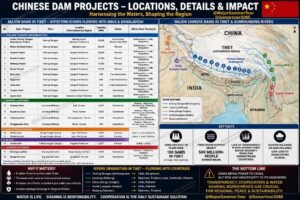
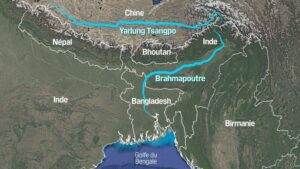
According to Nepal Correspondence on ‘X’, the disaster drill was held exactly at the same spot, that the mudflow hit Rasuwa on the Chinese side. The same handle also claimed that Chinese construction and cutting of hillsides to facilitate Xiaokang villages, created the conditions for the mudflow. However, larger picture of China’s irreverent damming of the Yarlung Tsangpo and the proposed Medog Dam (60 GW) sends out a warning sign to downstream nations like India and Bangladesh.
 Nepal’s Disaster Management Agency (NDRRMA), on 26 August, shared their preliminary assessment that the devastating flood, in Rasuwa, had been triggered by the sudden release of a river in Tibet, that had been blocked by an avalanche. The Agency claimed that they had received information about the blocked river only at 9 am. Adding, the flood had entered Nepal through the Lende River in Tibet and the Bhotkeshi River. China is aware that a similar GLOF (Glacial Lake Outburst Flood), event occurred last year on 8 July, in a China-Nepal transboundary river basin in Gyirong County, Tibet, which left 17 people missing and caused significant damage to bridges, hydropower stations, and roads. Given this, China should have been more proactive, in terms of transboundary information sharing, when the 2026 incident occurred. Such incidents do not require an agreement on information sharing; it should be a natural response to a humanitarian disaster.
Early Warning: The Difference Between Life and Death
 A social media post captures the human cost of an early warning — and what it can make possible. Rajendra Dawadi, the principal of Tribhuvan Trishuli Secondary School, in Nuwakot, Nepal, reportedly managed to evacuate about 900 schoolchildren, after receiving just 10 minutes’ warning of the impending flood. Those 10 minutes may have made the difference between life and death.
Remarkable what early warnings can do to save lives. Similarly, when the mud flood hit Uttarakhand in India in August 2025, early warning was the key to saving several lives, even though entire villages and urban settlements were washed away. Something that was dramatically witnessed in Nepal recently due to social media. Of course, the Indian disaster is said to have been caused by intense cloudburst rainfall, unlike in Nepal where a GLOF occurred.
Given the fact the entire Himalayan region is prone to such incidents, clearly, there is a need for sub-regional cooperation on climate change and ecological disasters. The challenge remains, however, of political bureaucracies across the region, stalling regional cooperation in this area.
BIMSTEC Himalayan Science Council needs to meet
Two things are important from a long-term perspective. The first priority is to convene a meeting of the Himalayan Science Council (HSC), of the BIMSTEC nations, to analyse what went wrong in Nepal in 2026. Thus far only two HSC meetings, one in 2021 and another in 2023 have been held. Pertinently, one of the Working Groups established under the HSC, is the Glaciology and Hydrology Working Group. There is ample reason for early convening of this group to discuss challenges arising from the Nepal crisis.

The other issue that needs attention is the research produced by the Wadia Institute of Himalayan Geology (WIHG) based in Dehradun. As an illustration, it might be mentioned that one of their recent studies is a comprehensive assessment of approximately 1,200 glacial lakes, in the higher Himalayan regions of Uttarakhand. Out of 426 lakes classified as “large” (covering more than 1,000 sq m), WIHG formally identified 25 lakes, as hypersensitive or highly sensitive to potential burst. This kind of ground-based research could be fed into the BIMSTEC Working Group. Also, the BIMSTEC HSC could commission a time-bound study on the recent Nepal crisis and suggest ways to improve early warning systems, at least within the BIMSTEC framework.
Disaster Management: India, China and the Early-Warning Gap
India’s National Disaster Management Agency (NDMA), in 2024 set up a Committee on Disaster Risk Reduction focused on GLOF. This Committee monitors high risk glacial lakes across the Himalayan region. It has prepared a list of 195 high risk glacial lakes, that are exhibiting rapid increases in surface area and could be susceptible to glacial outbursts.
China has its own Glacial Lake Management System (GLMS) established in 2019, which according to a study in Science Direct, integrates Early Warning Systems, engineering measures, and community responses. According to the study, modelling shows GLMS engineering measures could reduce future flood intensity by 24% overall, with greater reductions outside China (29%) compared to within China (21%).
However, more than having a system in place, the challenge of transborder action to mitigate climate change risks, persists. The long-term will require more cooperation and collaboration than competition.
India may often be the first responder when disaster strikes in the region. But rescue and relief can only go so far. The real challenge is prevention — and that requires countries across the region, including China, to put effective early-warning systems in place and ensure that warnings reach those at risk before disaster strikes.