 Kalyan Chatterjee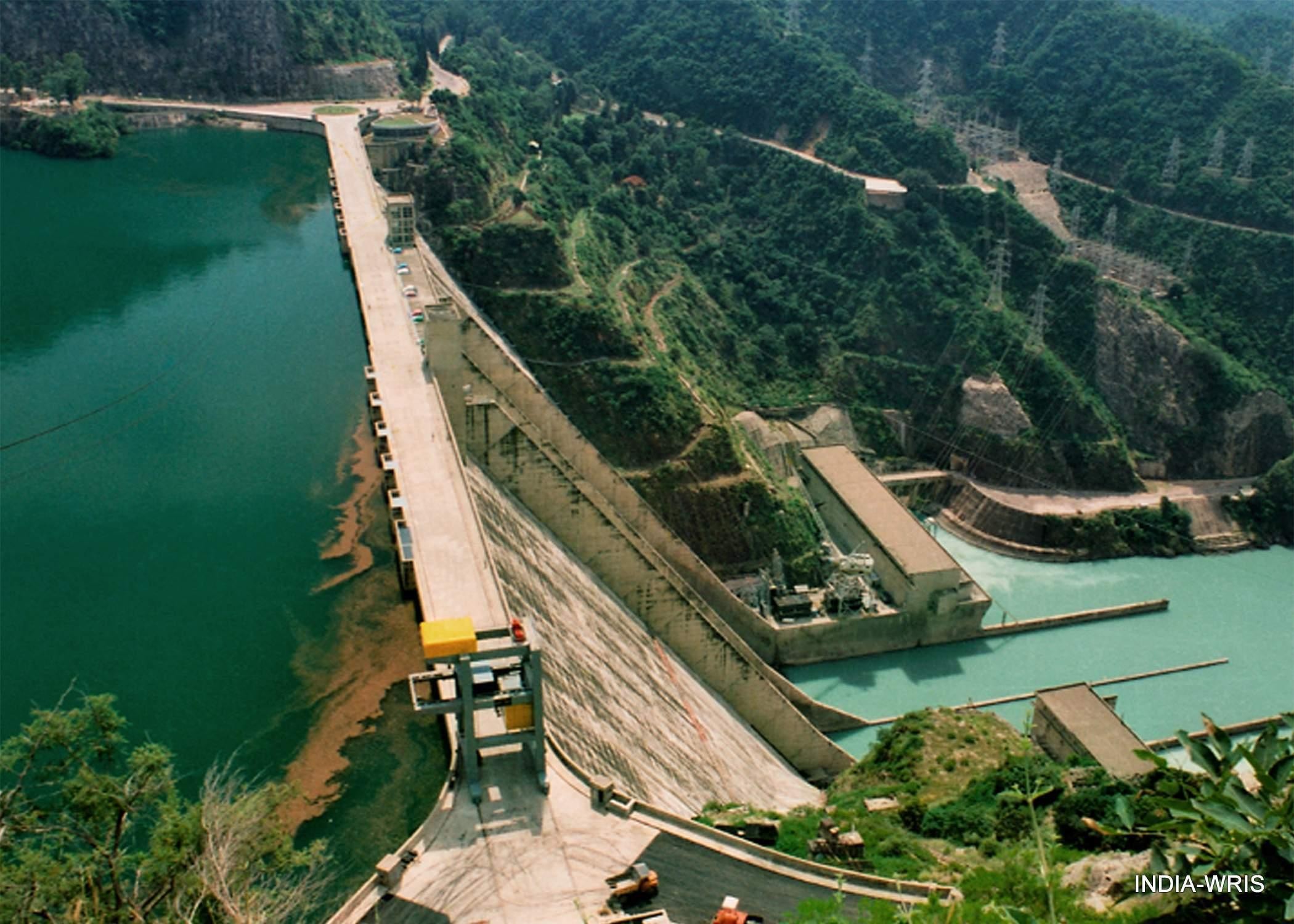
Water Dispute with Pakistan in 1948
Less well remembered today is the dispute with Pakistan that nearly brought the Bhakra-Nangal project to a halt. Pakistan’s objection to the reduction in waters in the Sutlej almost brought the project to a stop. After an initial Inter-Dominion Agreement between India and Pakistan in 1948, negotiations over the sharing of the river waters dragged on for more than a decade. The deadlock was finally resolved in 1960 with the signing of the Indus Waters Treaty, brokered with the mediation of the World Bank.
The episode also revealed an important aspect of Jawaharlal Nehru’s approach to the dispute. He remained conscious of the consequences that any disruption of the river waters could have for ordinary people in Pakistan, even as he resisted what he regarded as prolonged delaying tactics by its government. In 1954, while inaugurating the canal system of the Bhakra-Nangal project at Nangal, Nehru spoke at length about the disagreement with Pakistan, underscoring both his concern for the people on the other side of the border and his determination to see the project move forward.
Bhakra-Nangal: The Challenge of Preserving a National Legacy
Turning to the performance of the Bhakra-Nangal dam, it has kept its promise providing 137 MW of power to a power-starved nation and helping lay the foundation for the Green Revolution by irrigating large tracts of farmland in Punjab, Haryana and Rajasthan besides providing drinking water to millions. But earlier this year, concerns over the dam’s safety resurfaced in Parliament, when Anurag Thakur, former Union minister and Member of Parliament from Hamirpur, Himachal Pradesh, raised the issue in the Lok Sabha in March 2026.
The dam was built at Bhakra village (Himachal Pradesh), across the Sutlej in a gorge in the lower Shivalik, at a height of 2,200 feet. Another dam was built 14 km downstream at Nangal in Ropar that works in conjunction with the Bhakra Dam. The 740-foot dam created the Gobind Sagar Reservoir, spread over 168 square km and stores a huge 9.34 billion cubic metres of water. Deflection is caused in the dam wall by the pressure exerted by this huge volume of water. The government admitted that there was indeed deflection in the dam but gave an assurance that as of now it posed no danger to the dam.
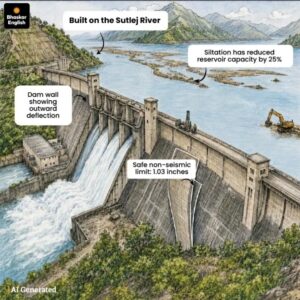
Giving details in his answer, Minister of State for Power, Sripad Naik, said that according to the Bhakra Beas Management Board (BBMB) Bhakra Dam, recorded a maximum deflection of 1.1770 inches on November 19, 2025. The design limiting value for deflection under non-seismic conditions is 1.03 inches specified by the designer, United States Bureau of Reclamation (USBR) trial load study, 1964. He further said that on March 10, 2026, the deflection of dam was about 0.9623 inches which was well within permissible limits as were seepage and stress. Periodic monitoring of these parameters is carried out through instruments installed at the time of its construction.
About action to deal with the situation, he said, the BBMB planned a controlled draw down of the Bhakra Dam reservoir during the summer months to the minimum draw down level (MDDL) of 1462 feet, so that the full reservoir level (FRL) – (MDDL) cycle could be completed to restore the structural elasticity of the dam. De-siltation operations would also be undertaken during the reservoir drawdown period. Bhakra’s live storage capacity has declined steadily as sediment accumulates on the reservoir bed, reducing the buffer available precisely when inflows are abnormally low. For the past 10 years, the water level at the dam’s reservoir, Gobind Sagar Lake, has failed to recede to its minimum draw-down level of 1,462 feet. BBMB has commissioned a deep study of the problem by the International Centre of Excellence for Dams (ICED) at IIT-Roorkee.
However, the de-siltation work is yet to begin since there is disagreement between the estimates of the BBMB and other experts on the amount of silt accumulation in the Gobind Sagar Reservoir. A bathymetric study by IIT Ropar has found that BBMB estimates of the amount of accumulated silt is higher than the actual amount of silt. Therefore, the storage loss estimates of the BBMB is also higher than what the study found.
According to a recent report in ‘The Tribune’, senior BBMB officials attributed the variation in findings to the advanced survey techniques adopted by the IIT team. The paper quoted the officials as saying – the institute had used modern bathymetric surveys, drone-based mapping and much denser cross-sectional measurements to assess sediment deposits. According to the officials, the IIT scientists conducted surveys at intervals of about 30 metres, enabling them to capture finer variations in the reservoir bed. In contrast, BBMB’s surveys relied on cross-sections spaced approximately 610 metres apart.
Bhakra dam was designed by the USBR in 1952. On completion, re-analysis of stability and structural adequacy by Trial and Load Analysis in accordance with assumed foundation excavation profiles, elastic properties of the foundation rock and concrete and construction program was carried out in 1964. The computed value of maximum deflections, as per later studies done in 1964, are 1.53 inches (38.86mm) for seismic condition and 1.03 inches (26.16mm) for non-seismic conditions, according to a study carried out jointly by Indian government agencies and a Canadian university in 2021, as part of the World Bank funded- Dam Improvement and Rehabilitation Programme (DRIP).
But the deflection in 2025 was not an isolated event, the study found that the dam wall had deflected on several occasions in the past. “Scrutiny of maximum deflection observed from 1964 using plumb line installed in Block 20, indicates that maximum and minimum deflection exhibited increasing trend. Further, during the years of 1995, 1998, 2008, 2010, 2011 and 2013, maximum deflection was more than 1.03 inches.
This study too, did note any visible signs of distress, seepage or problems in operation of spillway gates. But at the same time, it warned that since deflection in deepest block continued to show an increasing trend and has crossed the maximum design permissible limits for Bhakra dam, safety of the structure is a question that needed to be addressed considering the huge risk associated with this massive structure.
From Partition to the Indus Waters Treaty
The Bhakra Project also carried an international dimension, rooted in the partition of Punjab and the division of its five rivers between India and Pakistan. The partition left the western reaches of Punjab in Pakistan and the eastern portion in India, turning the question of river waters into an immediate source of dispute between the two countries. The issue was eventually addressed through the Indus Waters Treaty of 1960, which established a framework for sharing the waters of the Indus river system. More than six decades later, the treaty has once again become a subject of intense scrutiny, particularly over the Kishanganga hydropower project in Jammu and Kashmir.
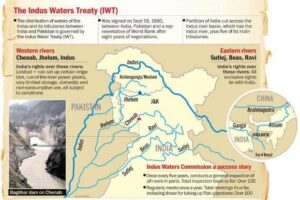
The problem arose in 1947 as the Radcliffe Line that defined the boundary between West Pakistan and India left the headworks of the Punjab rivers in India, while the canal system went to Pakistan. This naturally created a fertile ground for disputes between the two newly created countries that were at loggerheads with each other.
In the charged atmosphere of those times, the two countries viewed every action of the other with great suspicion. Despite rancour between the two countries, they managed to sit down and draw up a temporary agreement in May, 1948 called the Inter-Dominions Agreement on Canal Waters. By this Agreement of 4 May 1948, India agreed to resume the supply of waters to Pakistan. In July 1948, at an Inter-Dominion Conference held at Lahore, Pakistan was allowed seven years to develop alternative sources of water supply. In exchange Pakistan would remit Rs. 12 lakhs annually into an escrow account in the Reserve Bank of India till the final settlement of the dispute.
However, Pakistan went back on the Agreement saying that their consent had been obtained under duress. An impasse was reached in the negotiations with Pakistan seeking the legal route, when in June 1949 it wanted the matter to be referred to the International Court of Justice. But Pandit Nehru was averse to what he called “legal quibbles.” So, when the World Bank offered to mediate, he jumped at the offer. The Bank created a group of engineers from both countries to address the issue, but Pakistan continued to drag its feet till it was forced to respond to a fresh Bank proposal in 1954. The negotiations resulted in Indus Waters Treaty which was signed in 1960 by Pandit Nehru and Pakistan President Ayub Khan. Under the Treaty, the three eastern rivers – Sutlej, Beas and Ravi – were to be controlled by India and the western rivers – Indus, Chenab and Jhelum were to be controlled by Pakistan. The Bhakra-Nangal Dam was inaugurated in 1963.
Conclusion
The Bhakra-Nangal project was conceived in an India that was still finding its feet. It was built not merely as a dam, but as an expression of national ambition — to generate power, irrigate fields, provide drinking water and demonstrate that a newly independent country could undertake projects on a scale once associated with the colonial state.
More than six decades later, its legacy remains difficult to dispute. But time has changed the nature of the challenge. The question is no longer whether India can build such a structure; it is whether it can preserve, monitor and modernise one whose importance has only grown with the passage of time.
The reported variations in deflection, the accumulation of sediment and the differing assessments of the reservoir’s lost storage capacity do not, by themselves, establish that Bhakra is unsafe. The government has said that the dam remains within permissible operational parameters, while studies have called for continued attention to the trend in deflection. What they do establish is the need for vigilance — and for the science underlying decisions about the dam to be transparent, continuous and beyond institutional disagreement.
Bhakra-Nangal was once a symbol of a young nation looking towards the future. Its preservation is now a test of a more mature India: one that must protect the infrastructure on which millions depend while preparing it for the demands of another generation.
The greatest tribute to the vision behind Bhakra would not be to assume that the monument is indestructible. It would be to ensure, through independent assessment, modern technology and timely maintenance, that the dam continues to serve the people for whom it was built.
The temple of modern India, as Nehru called it, has stood for more than sixty years. The responsibility now is to make sure that it can stand securely for many more.