 Kalyan Chatterjee
The Heat Is Reshaping Europe:
Mayor Sadiq Khan has called for air conditioning in schools, hospitals and offices in London.

In Bonn, Germany, the mercury has risen to 39°C and it is the same in capital Berlin as in cities and towns across Western Europe where people are cooling themselves in public fountains and water mist fans. A severe heatwave grips Europe with France on red alert and bracing for its hottest day ever. Spain, Germany, Italy, and the UK also face extreme temperatures, school closures, and health warnings. Temperatures have already reached 41°C (105.8°F) in some areas of France, and Paris is expected to see thermometers exceed 40°C for the first time in June.

Even Switzerland, renowned for its winter sports and ski resorts has been hit by the heatwave. Swiss Federal Office of Meteorology and Climatology (MateoSwiss) has warned that temperatures will reach 34°C to 37°C in many areas until next Monday – and until Sunday on the southern side of the Alps – with maximum temperatures expected to rise slightly from Thursday onwards.
In Spain, a public screening of a World Cup match between Spain and Saudi Arabia in Madrid was cancelled due to temperatures reaching 39°C. The Spanish football federation deemed it unsafe for fans to gather in the fan zone. The heatwave has already claimed lives across Europe. In France, a 30-year-old man died after collapsing on an athletics’ track near Paris. Seven heat-related deaths have been reported in France during the June heatwave, following 101 heat-related deaths recorded in Spain during May — the highest monthly figure since records began in 2015.
As Europe Swelters, Heat Turns Deadly:

Drowning incidents have also risen sharply. In northeastern Spain, three boys aged 12 and 13 died after jumping from rocks into the sea and being unable to return due to strong waves. In Germany, three swimmers are missing after swimming in the Rhine, and a 23-year-old man drowned in a lake near Karlsruhe. In France, a 17-year-old boy died after being swept away by the current of the Dordogne River.
The Heat Dome Behind Europe’s Scorching Summer:
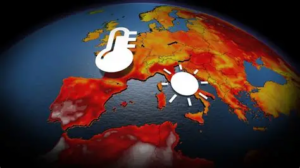
The heatwave is driven by a powerful heat dome — a high-pressure system trapping hot air from North Africa over Western Europe. This phenomenon has made the event comparable in intensity to the deadly August 2003 heatwave that killed an estimated 15,000 people in France.
The term ‘heat dome’ is used when a broad area of high-pressure air parks over a large portion of the continent. If the event is remarkably stable and extreme, it usually lasts several days or weeks. When hot air moves from the ground it is pushed down by the high-pressure dome making the surface areas even warmer.
Fingerprints of Climate Change- The Heat Is Human-Made
The heatwaves have been blamed on climate change induced by human activity. A report submitted by the UK Climate Change Committee to Parliament says that the period between October 2022 to March 2024 was the wettest 18-months on record for England. Large amounts of farmland were underwater for long periods, which led to the second worst arable harvest in England since modern harvest records began. This came on the back of record-breaking heatwaves in summer 2022, which saw temperatures exceeding 40°C for the first time in many places and resulted in a record level of nearly 3,000 heat-related deaths recorded in England.
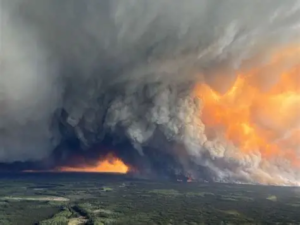
Simultaneously, the hot and dry conditions in summer 2022 led to an unprecedented number of wildfires, with many fire and rescue services declaring major incidents in July 2022 following a 500 per cent increase in emergency calls.
The record-breaking heat in 2024 followed a year of exceptionally high global average temperatures in 2023. 2024 marked the first time that the global annual average temperature exceeded 1.5°C above pre-industrial levels, with the five-year running average currently above 1.3°C. Europe continues to heat more rapidly than the global average, with temperatures during the past five years averaging around 2.4°C above pre-industrial levels, according to 2024 European State of the Climate Report.
The Report said ocean temperatures mirrored the extremes on land, influenced in part by the lingering effects of El Niño, which peaked in late 2023. Many ocean basins recorded higher-than-average or record-breaking sea surface temperatures, with the Mediterranean experiencing its warmest year on record at 21.5°C average, 0.3°C above the previous record. Combined with extreme heat on land, globally these hotter ocean temperatures contributed to accelerated ice loss from glaciers and ice sheets, pushing global sea levels to their highest point in the modern record.
Referring to the European heatwave, UN climate chief Simon Stiell said, “The savage heatwave has the fingerprints of the climate crisis all over it”. Further he warned that, “until humanity stops burning coal, oil and gas, extreme heat will keep getting worse”, highlighting the need for countries to accelerate the shift to renewable energy, protect forests and boost climate resilience.
Mappr compiles data the highest temperature recorded in each country in Europe, along with the location and year of the recording.
| COUNTRY | RECORD | LOCATION | YEAR |
| Albania | 44.0°C | Kuçovë | 2023 |
| Andorra | 39.4°C | Borda Vidal | 2019 |
| Austria | 40.5°C | Altenburg | 2013 |
| Belarus | 38.9°C | Gomel | 2010 |
| Belgium | 41.8°C | Begijnendijk | 2019 |
| Bosnia and Herzegovina | 46.2°C | Mostar | 1901 |
| Bulgaria | 45.2°C | Sadovo | 1916 |
| Croatia | 42.8°C | Ploče | 1981 |
| Czech Republic | 40.4°C | Dobřichovice | 2012 |
| Denmark | 36.4°C | Holstebro | 1975 |
| Estonia | 35.6°C | Võru | 1992 |
| Finland | 37.2°C | Liperi | 2010 |
| France | 46.0°C | Vérargues | 2019 |
| Germany | 41.2°C | Duisburg-Baerl | 2019 |
| Greece | 48.0°C | Athens | 1977 |
| Hungary | 41.9°C | Kiskunhalas | 2007 |
| Ireland | 33.3°C | County Kilkenny | 1887 |
| Italy | 48.8°C | Syracuse | 2021 |
| Latvia | 37.8°C | Ventspils | 2014 |
| Liechtenstein | 37.4°C | Ruggell | 2003 |
| Lithuania | 37.5°C | Zarasai | 1994 |
| Luxembourg | 40.8°C | Steinsel and Remich | 2019 |
| Malta | 43.8°C | Malta Airport | 1999 |
| Moldova | 42.4°C | Fălești | 2012 |
| Monaco | 35.1°C | Monaco | 2022 |
| Montenegro | 44.8°C | Podgorica | 2012 |
| Netherlands | 40.7°C | Gilze en Rijen | 2019 |
| North Macedonia | 45.7°C | Demir Kapija | 2007 |
| Norway | 35.6°C | Nesbyen | 1970 |
| Poland | 40.2°C | Prószków | 1921 |
| Portugal | 47.4°C | Amareleja | 2003 |
| Romania | 44.5°C | Ion Sion, Brăila County | 1951 |
| Russia | 45.4°C | Utta, Kalmykia | 2010 |
| San Marino | 40.3°C | Serravalle | 2017 |
| Serbia | 44.9°C | Podunavlje | 2007 |
| Slovakia | 40.3°C | Hurbanovo | 2007 |
| Slovenia | 40.8°C | Cerklje ob Krki | 2013 |
| Spain | 47.6°C | La Rambla | 2021 |
| Sweden | 38.0°C | Kalmar County | 1947 |
| Switzerland | 41.5°C | Grono | 2003 |
| Turkey | 49.5°C | Sarıcakaya | 2023 |
| Ukraine | 42.0°C | Luhansk | 2010 |
| United Kingdom | 40.3°C | Coningsby | 2022 |