 Dr. Bhashyam Kasturi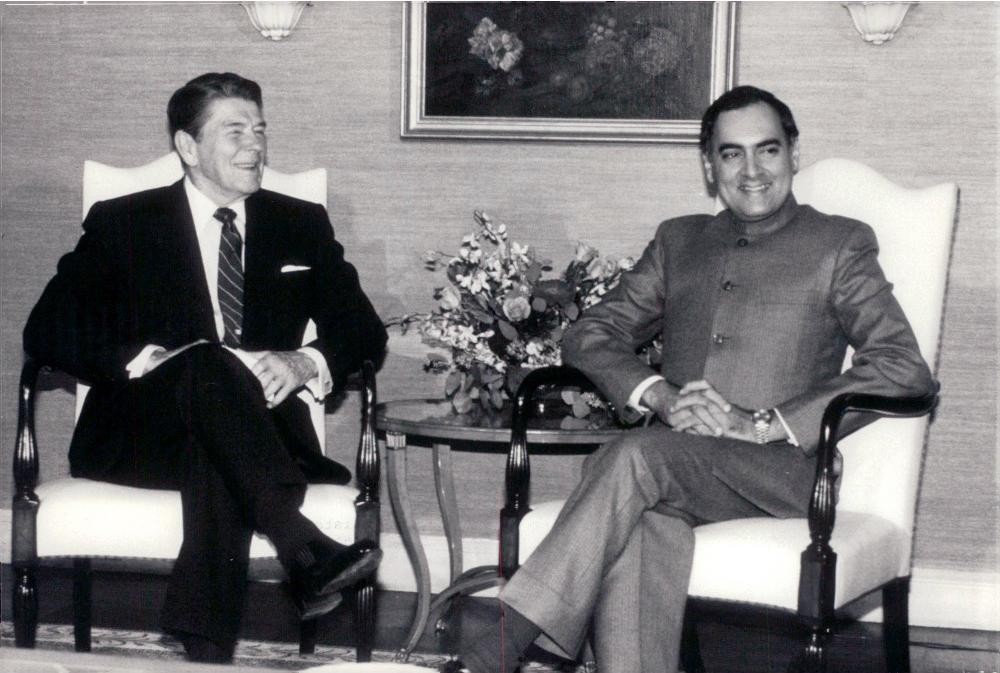
The Rajiv Gandhi Era incident
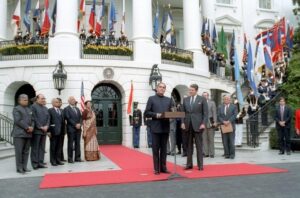
In October 1985, Prime Minister Rajiv Gandhi visited the United States and met with President Ronald Reagan. In private conversations, the US President told Rajiv Gandhi that Pakistan had “already made the bomb”. There is a declassified document dating back to 1983, in the US National Security Archive, possibly from the CIA, that stated “There is unambiguous evidence that Pakistan is actively pursuing a nuclear weapons development program. Pakistan’s near- term goal is to have a nuclear test capability.” The proof of the pudding came in January 1987 when A.Q. Khan told Kuldip Nayyar that Pakistan had successfully acquired the bomb.
While Ronald Reagan warned Rajiv Gandhi, the latter wanted to ensure that India’s counter-move to acquire nuclear weapons, had a Pakistani threat quotient in mind. He did two things then; first he ordered the setting up Committee in 1986 to have a nuclear weapons roadmap for India. Second, and a little earlier, he told S.K. Singh, then India’s High Commissioner to Pakistan, to gain incontrovertible evidence that Pakistan had acquired the bomb. In an interview to Neerja Chowdhury, S.K. Singh later recalled that after Rajiv Gandhi was given the intelligence on Pakistan’s nuclear weapons programme, he had given instructions to go full steam ahead on India’s bomb, but this was never formally recorded. He also stated that he received directions from the PM to obtain whatever information he could from Kahuta, Pakistan’s first nuclear power plant, some 22 km from Islamabad.
Two things apparently happened. First, listening posts were set up on top of the High Commissioner’s personal residence in Islamabad to obtain information from Balochistan and NWFP, possibly of testing signals and other forms of SIGINT. The possibility of India setting up “listening posts” in Islamabad at the time appear to be thin, it is more likely that R&AW acquired the capability to intercept signals from Pakistan with much greater intensity and clarity around the time and possibly with US assistance.
A second order that S.K. Singh received from the Prime Minister Rajiv Gandhi, was to set up a barber shop close to the nuclear plant at Kahuta to obtain samples of hair from workers in the nuclear plant. It is more probable that barber shops were already there in close proximity to the Kahuta plant and R&AW collected the hair samples from there. Bharat Karnad first revealed in his 2002 book that India’s Department of Atomic Energy had asked the R&AW to collect the hair samples. These were duly collected and scientific tests at BARC, Trombay confirmed trace levels of radiation and weapons-grade uranium. Thus, it was proved that Pakistan had officially mastered the technology required to enrich uranium for a bomb. Of course, this was not a one-off input, but one part of the entire effort.
Black Tiger and Kahuta
The first operation relating to Kahuta was undertaken by Ravindra Kaushik, aka the “Black Tiger”, who was infiltrated into Pakistan in 1975 by R&AW and subsequently, joined the Pakistan Army and rose to become a Major. Amongst his many achievements in terms of gathering intelligence, was to cultivate a source within the Kahuta nuclear plant, who showed his willingness to share the blueprints of the plant for a prize. But this could not go through because the then prevailing antipathy towards R&AW shown by Prime Minister Morarji Desai, both in terms of funding and an ill-founded view, that the agency had been used as a tool to gather political intelligence and target the opposition. Desai’s subsequent telephonic boast to Pakistan’s President General Zia-ul-Haq about having inside knowledge of the workings of Kahuta, sealed that source of information for India. The Indian plan was probably to obtain the blueprints of Kahuta, with the ultimate objective of sabotaging it.
Former R&AW Additional Secretary, B. Raman, while recounting the Morarji-Zia call, later concluded, “Indiscreet political leaders are the unavoidable occupational hazards of the intelligence profession”. Former Pak Army Chief General K.M. Arif, in his memoirs, also recalled the Morarji conversation and states that ‘this led to a strengthening of counter-intelligence measures in Kahuta by the ISI and the military’. This is the manner in which R&AW obtained crucial intelligence on Pakistan’s nuclear programme.
The Barber Shops Narrative
In the 1980s, the R&AW mission was more specific. Having come to know from the Central Intelligence Agency (CIA) that Pakistan was close to or had developed a nuclear bomb, Rajiv Gandhi wanted to be certain, so he authorised a R&AW operation, to ascertain proof on the ground. That is what led to the “barber shops” spying mission. These efforts were really part of the wider government initiative to track and monitor Pakistan’s nuclear programme. As an instance, one can cite the Joint Intelligence Committee report of 1979, which confirmed that Pakistan was in possession of centrifuge technology for uranium enrichment. Fitting the dots on Islamabad’s ability to make the bomb must have taken time, but the early efforts which must have included both HUMINT, SIGINT and intelligence from friendly nations have contributed to the building of the larger picture.
What made the intelligence in Rajiv Gandhi’s time significant was the political decision to go ahead to build India’s bomb and the inclusion of General Krishnaswamy Sundarji, the then Vice Chief of Army Staff, in the committee which recommended the roadmap for India. Pertinently, it was General Sundarji who introduced nuclear warfighting into the Indian lexicon and brought in the armed forces as a factor.
The India-Israeli plan to attack Kahuta
All the pieces in the jigsaw puzzle of Pakistan’s nuclear programme were never available in one place at the same time. The external sources of information for R&AW at the time would have been Israel and the US. After all, it was Israeli Defence Minister who came to India in 1977 and suggested a joint air strike on the Kahuta plant. The proposal was rejected by Prime Minister Morarji Desai. Of course, the actual military plans were drawn up in 1981-82 and shown to Indira Gandhi when she was back in office. The Washington Post carried a report in December 1982 claiming that Indira Gandhi did not reject the proposal outright, but kept it on the backburner till around early 1984 when it was shelved. The story of R&AW and Pakistan’s nuclear weapons programme, shows a number of hits and misses, as also the relentless effort put in by the agency to track down the weapons programme.