 Dr. Bhashyam Kasturi
Will Cyberattacks create the next disaster?

In the last several weeks, more than eighteen countries worldwide had warned their citizens to stock up on food, water and other rations.
Was this anticipation of a Third World War? It was more likely anticipation of cyber-attacks and this is precisely what has happened in the past one week. Massive cyberattacks on refrigeration and cold storage systems across Europe have struck supermarkets and elsewhere. The other news of import is the pulling out of US$ 6 billion from Binance. Across US, Federal authorities ordered ground stops at seven major airports just ahead of the UNGA, in New York, in September 2026. More recently, the Washington DC area experienced outages of power for several hours a day prior to the mid-term elections. Both IMF and the World Bank lost power during the incident. The latest incident on November 6, 2026, was disruptions caused by a technical hitch to Japanese credit banks and focused mainly in western Japan. Around 128 shinkin banks, or credit cooperatives, faced a major technical failure, disrupting banking operations temporarily, bringing ATM transactions, branch services and internet banking to a halt, affecting approximately 3,430 branches and leaving customers unable to access several essential banking services.
Crypto Heist at Binance
The biggest crypto heist at Binance on October 29, 2026, worth approximately US$6.36 billion, is allegedly the work of North Korean hackers. They have done so in the past also on several occasions.

The US Federal Bureau of Investigation (FBI), in coordination with the US Secret Service and blockchain analytics firms such as TRM Labs, attributed the attack to ‘TraderTraitor’, a cyber threat actor associated with North Korea’s Lazarus Group, a cyber warfare unit allegedly operating under North Korea’s military intelligence agency. The notable point about this group is – it works gradually using a number of steps to achieve its goals. It first targets software engineers and HR personnel with promises of fake employment or opportunities. After that it sends malicious “coding tests” or pre-employment assignments that infect work devices. This is precisely why such hacking is more dangerous than direct code attacks.
Similarly, Axios reported that major US banks including JPMorgan Chase, Bank of America, Morgan Stanley, Wells Fargo, and Citigroup, reported in October 2026, unauthorised AI agents getting access to numerous customer accounts. Pertinently, this was not a traditional hacking incident but occurred when customers passed on their IDs and passwords to AI agents, the latter then activating unauthorised transactions. This means that vulnerabilities also exist in situations where AI misuses data provided unintentionally by an account holder.
A similar incident happened with the State Bank of India (SBI) recently, when the account details of over 3.75 customers were breached and made public. A threat group named ‘Siriusim’ claimed access to these records, as well as over 2,700 PDF documents. The first indicators of a threat were received on October 16, 2026, from the Defence Cyber Agency, Indian Computer Emergency Response Team (CERT-In), and SBI’s threat intelligence provider. However, the formal disclosure was made only on October 21, 2026. The SBI data breach was discovered after 3,897 customer records containing Personally Identifiable Information (PII) were seen on the dark web. SBI came to know about the leak from external intelligence agencies, rather than internal detection. Fortunately, core banking operations and customer funds remained unaffected.
The Japanese technical glitch!

The incidents of outage in Japan’s banks due to a technical hitch demonstrates that a banking crisis may not necessarily be a cyberattack. The Shinkin (cooperative) banking outage in Japan highlights a growing vulnerability in modern banking which is shared infrastructure. A failure of this infrastructure (hardware and communication equipment malfunction), at the Shinkin Kyodo Center, disrupted services across thousands of Japanese bank branches. The Shinkin Kyodo Centre is a shared technology operator that manages core banking infrastructure for cooperative regional lenders. Only a year before, a power disruption and hardware failure at a core banking provider caused account access and payment issues for U.S. customers. Notably, neither incident involved any cyberattack, yet both attacks left customers unable to access their funds temporarily, for five hours in the case of the Shinkin banks. These events demonstrate that reliance on shared technology providers, increases the potential for operational risks that can spread across entire networks when their infrastructure fails.
The assault on Europe’s cold storage

Europe’s food industry has also been strained by the wave of cyberattacks recently. Starting gradually last month and escalating dramatically in November 2026, these attacks created conditions where commercial establishments were forced to blow hot air, resulting in the loss of millions of Euros, in lost food and damage to cold storage systems in at least ten countries. Instead of maintaining sub-zero temperatures to keep the food frozen, the freezers reportedly malfunctioned, with temperatures soaring to as high as 50°C (122°F), potentially compromising the entire stock of perishable food. This caused physical components in some systems to melt or catch fire. The attacks on cold storage in Europe come very close to onset of winter.
There has been no demand for ransom and no claim made taking responsibility. So, whoever is behind this was merely signalling that the capability exists and that this was a trial run.
The first wave in October hit French supermarkets, while the November attacks were more pan-European. More than 700 French supermarkets were hit by this attack, which the authorities attributed to Iran’s Revolutionary Guards.
Subsequently, supermarkets and stores in Sweden, Ireland, Finland, Estonia and Portugal were hit. As a specific example, more than 40 Delaize supermarkets across Belgium and Luxemburg were targeted. Just one Delhaize store in Belgium lost Euro 100,000 worth of food.
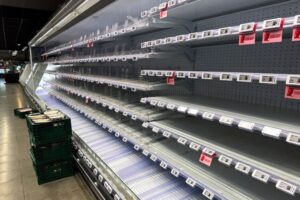
The internet is undoubtedly a boon, but the latest incidents have exposed their vulnerabilities too. Those involved in understanding the attacks and suggesting recovery, can appreciate that such vulnerabilities need physical modifications in the units and not merely a software patch.
US authorities are undertaking investigations into similar refrigeration failures at their military bases that occurred in August 2026. Collaboration between US and France is underway to understand if there are any linkages between the US and European attacks.
The underlying concern is that such attacks can be both random and focused, each with its own set of challenges. Thus noted, every sector of the world economy is interlinked and vulnerable. National economies can also be attacked in sectors like energy and health, making it imperative to be forewarned and prepared.
Stocking up for the worst?
This takes us back to the original warning issued by several countries, asking their citizens to store food and water. With the latest cyber-attacks, more countries have joined the bandwagon.
But the rationale is a combination of factors including geopolitical tensions, looming fuel crisis and shortages created by other risks.
Most countries, like the UK, issued a three-day storage warning to minimize risks attendant from power outages and food shortages. Japan also warned of a three-day rationing and sought an ideal week-long rationing system. While the Nordic countries also recommend a week-long reserves capability, Germany is asking its citizens to stock up for a minimum of ten days.
Obviously, the rationale for nations to choose certain days depends on the nature of the threat assessed and chances of recovery. However, the key here is that governments are asking citizens to prepare for situations in which they are living independently, cut off from their governments. That by itself is far more significant than before.
In India’s case, the National Disaster Management Agency has asked people to keep emergency kits handy, but there is no announcement of food and water storage. Recall that during Operation Sindoor, orders were issued for civilians to be prepared for speedy evacuation in anticipation of wider Pakistani attack on civilian areas. Fortunately, this did not happen. Cyber security has thus gained considerable importance in national security terms. The CERT-IN is the nodal agency to warn governments and citizens of such attacks.
The question of when and how such attacks could occur is as important as being prepared to counter and protect one’s systems. This will require a wider industry-government partnership with the National Cyber Security Coordinator in the National Security Council Secretariat, acting as the coordinator to better appreciate and prepare India for the worst.
.wp-caption-text,
.single_thumbnail56 figcaption,
.thumbnail56 figcaption,
.wp-block-image figcaption,
.blocks-gallery-caption {
font-size: 11px !important;
text-transform: capitalize !important;
}