 Dr. Bhashyam Kasturi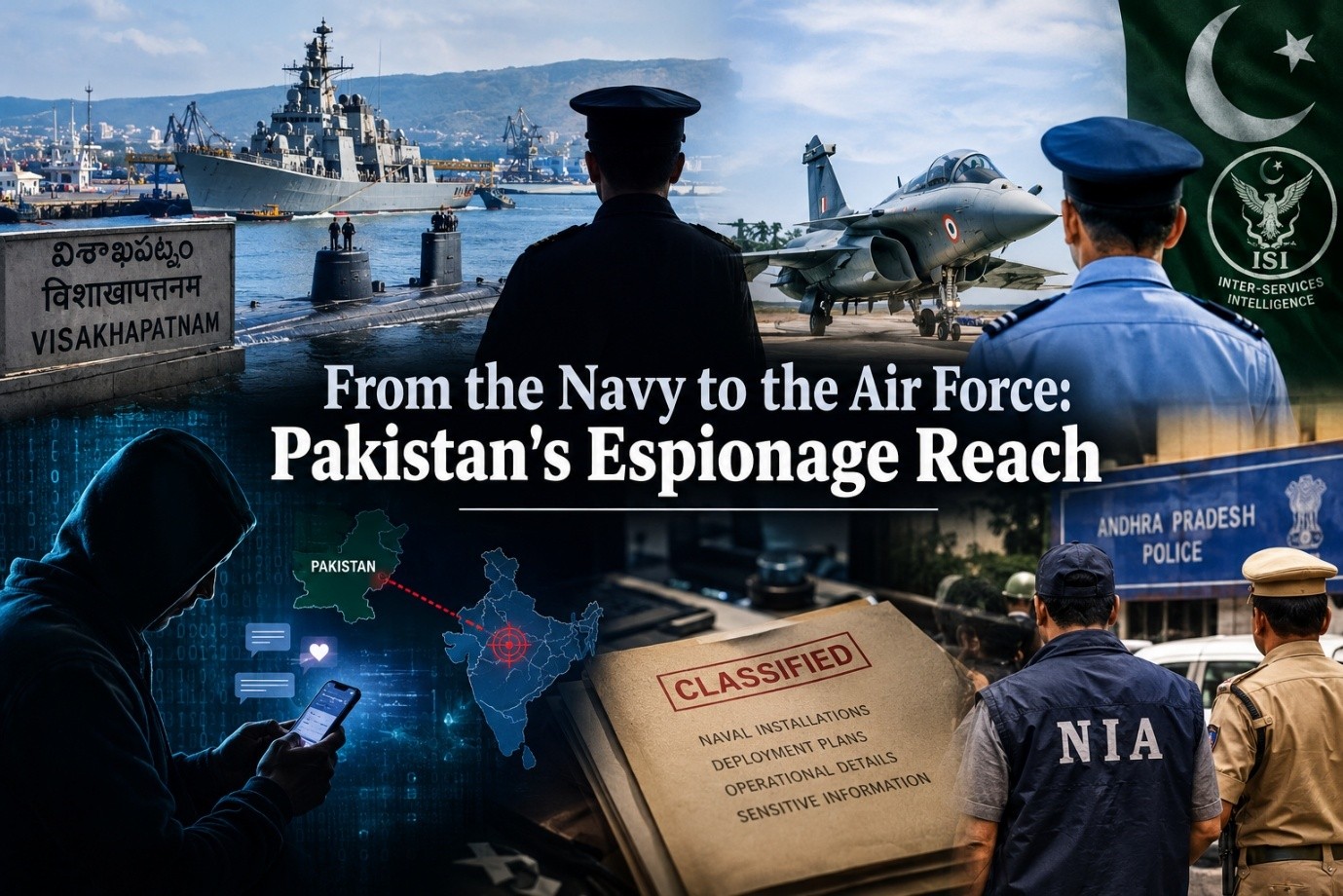
The Spy Game in Eastern Naval Command
One of the most important aspects of police and intelligence work is counter-intelligence and it is often the efforts of CI that lead to significant arrests. One such CI operation that has recently come to light – ‘Operation Firewall-2026’, launched by the Andhra Pradesh Police, in September this year, to uncover a espionage ring in Vishakapatnam, the HQ of the Indian Navy’s Eastern Naval Command.
Of note is the fact that 13 of the 18 accused are Navy personnel, making it probably the first time that such a large number of personnel from the Navy are under the lens. A month earlier, a serving Wing Commander of the Indian Air Force was arrested for sharing secrets with a Pakistani handler. Both these ongoing investigations hide more than what they reveal, a thriving ISI network within India, that uses technology to honey trap armed forces personnel and attempts to collect military information of value. While the police continues its work of finding out the actual damage done it is important to stress the value of CI, without who each such operations cannot be carried out.

The police arrested Pradeep Mukharjee, a Navy employee from the Visakhapatnam naval base, and Annam Sai Varaprasad, a civilian contract driver engaged for naval officers in Visakhapatnam. Mukharjee was arrested from Coimbatore, Tamil Nadu. He was produced before a court in Vijayawada and sent to judicial custody till 14 October. Varaprasad, the other accused, was sent for judicial remand till 14 October and he is also lodged in Vijaywada District jail. Likelihood of Central Agencies providing basic leads to the Andhra Pradesh Police cannot be ruled out. Also, this was an operation conducted in collaboration with Police in 10 other States and must have required time to bring all the evidence together.
Vizag Spy Cases Raise Alarms Over Naval Security…
The worrying fact is that this is not the first time such incidents have been detected. Last year, two persons were sentenced to five years imprisonment under Section 10 of UAPA. A total of six persons were arrested in 2019 for spying at vital installations including at Karwar and Mumbai, two were convicted only last year. At that stage also the NIA had taken over the case from the Andhra Pradesh Police, Intelligence Department for further investigations. All these cases have been tracked by the NIA and centered on classified defence information leaks to Pakistani Intelligence Operatives (PIOs) identified as Meer Balaj Khan and Alven. Multiple chargesheets and supplementary chargesheets have been filed against the accused, including Akash Solanki, Manmohan Surendra Panda, and Amaan Salim Shaikh.
Pakistan’s Spy Network Is Also Targeting the IAF
A serving Wing Commander of the Indian Air Force (IAF), was arrested in May 2026, by Delhi police for spying for Pakistan. He had been reportedly honey trapped into providing sensitive and secret information to Pakistan Intelligence Officers. The Wing Commander is also alleged to have installed software on his colleague’s phone to steal data. The Indian Air Force officer was allegedly honey-trapped by Pakistan’s Inter-Services Intelligence (ISI) and induced to share sensitive information about the unit to which he was posted along India’s Western Front. The case underscores how intelligence agencies can exploit personal relationships and emotional vulnerabilities to gain access to classified military information, turning an individual’s access into a potential security breach.
The above is an increased sign of activity by the ISI inside India, particularly targeting military personnel and installations. Post ‘Operation Sindoor’, this is a significant enhancement of surveillance of India’s military machine.
A comprehensive assessment of the information, allegedly passed on to Pakistan, is essential to determine the extent of the security breach, identify potential operational vulnerabilities and formulate effective countermeasures. Equally important is the need to strengthen existing security protocols, improve personnel vetting and monitoring, and introduce safeguards against honey-trapping and other methods of intelligence recruitment. Only a systematic review of the breach, coupled with corrective action, can help prevent similar incidents in the future.
Conclusion:
Arrests and investigations, important as they are, represent only part of the response. Protecting sensitive naval establishments requires sustained vigilance, robust internal security protocols and an institutional culture in which the safeguarding of classified information is treated as a collective responsibility.
The emerging cases in Visakhapatnam serve as a reminder that India’s maritime security depends not only on the strength of its ships, submarines and surveillance systems, but also on the integrity of the people entrusted with their secrets.
On the whole, these episodes reinforce the importance of counter-intelligence work and enhanced Centre-State cooperation in this field.