
 Kalyan Chatterjee
India’s Schools Are Shrinking. Are Reforms Working?
A 2026 report on school education by the NITI Ayog, attributes the contraction in India’s school education system, partly to demographic shifts, particularly falling fertility rates leading to a smaller school-age population, alongside the effects of school consolidation and challenges in retention at higher levels of education.
In this context it must be recalled here that the government has introduced two major changes over the last decade whose impact has not yet been assessed.
The first was the Samagra Shiksha Scheme (SSS), launched in 2018 as an ambitious effort to integrate the country’s fragmented school education framework. Conceived as a continuum stretching from pre-primary education through senior secondary school, the programme sought to address three persistent challenges: universal access, equity and educational quality. By bringing multiple schemes under a single umbrella, policymakers hoped to create a more coherent and efficient system capable of delivering learning outcomes at scale.
The second was the National Education Policy (NEP) 2020, a sweeping blueprint intended to reshape the country’s educational landscape. Subsequent modifications to the Samagra Shiksha Scheme were designed to align its objectives with the broader vision outlined in the new NEP.
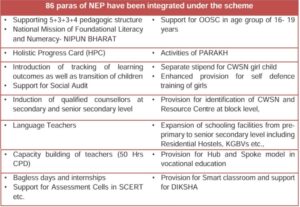
Yet the effectiveness of these reforms remains difficult to judge. Originally conceived as a three-year programme, SSS was later extended through 2025-26, reflecting both the scale of the undertaking and the unfinished nature of the task. As a centrally sponsored initiative, it relied on a cost-sharing arrangement between New Delhi and the states, with funding divided in a 60:40 ratio for most states and 90:10 ratio for the Himalayan and Northeastern regions.
The central question is whether these structural reforms have translated into measurable gains in access, retention and learning. The closure of thousands of schools and the sharp decline in enrolment suggest that the answer may be more complicated than policymakers anticipated. While ambitious policies can provide a framework for change, their success ultimately depends on implementation, accountability and sustained investment on the ground.
As India approaches the end of the scheme’s extended timeline, a rigorous assessment of its outcomes is no longer optional. It is essential.
An Enrolment Crisis:
In accordance with this thinking, the 2018-19 central budget proposed to treat school education holistically without segmentation from pre-school to Class 12, to improve school effectiveness measured in terms of equal opportunities for schooling and equitable learning outcomes. The education ministry said in its 2022 ‘SSS Framework’ for Implementation’, that integration would help harmonise the implementation mechanisms and transaction costs with an emphasis on ensuring access.
However, Prof. Arun C. Mehta of the analytics firm ‘Education for All’, in India, calls it “an enrolment crisis that demands urgent action”. A former official at the National Institute of Education Planning and Administration (NIEPA), Prof. Mehta, pointed out that closure of large number of government school in rural areas since 2017-18, are due to budget constraints, and certainly exacerbates access to schools.
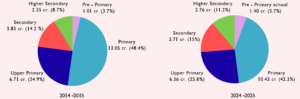
According to the NITI Ayog Report, enrolment in government schools dropped from 147 million in 2014-15, to 122 million in 2024-25, – a gap of 25 million. Enrolment in private schools, on the other hand went up from 86 million to 94 million during the same period but could not make up for the decrease in enrolment in government schools. The most worrying part is that the decline in enrolment occurred in the primary level, the first rung in the education ladder, sliding- down from 130 million to 104 million, lesser enrolment of 26 million.
GER Sharply Drops at Secondary Education:
While the slowing population growth has been held out officially as one of the factors behind the fall, a different picture emerges from figures of gross enrolment ratio (GER). GER measures the total enrolment in a particular level of education expressed as a percentage of the official age-group population for that level. If the total population of children in the primary age group has decreased due to a slowdown in population growth, then the GER should have risen because it shows a proportion rather than absolute numbers. But data shows that the GER has actually fallen from more than 100 per cent till 2021-22 to about 91 per cent in 2024-25. GER has dropped from 106.85 per cent in 2014-15 to 103.39 per cent in 2021-22 and 90.9 per cent in 2024-25.
“Under normal progression, the large enrolment recorded at the primary and upper primary stages in 2014-15 should have been reflected in significantly higher participation at the secondary and higher secondary levels by 2024-25. However, this has not materialised, as attrition across the school cycle has reduced the pool of students transitioning to higher grades”, according to the NITI Ayog Report.
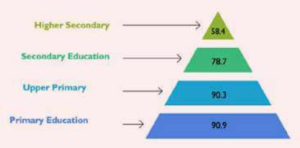
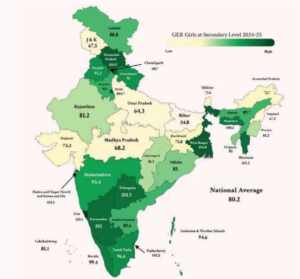
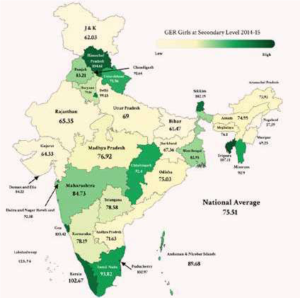
As it is, GER sharply drops to about 79 per cent at the secondary level while it further goes down to 58 per cent at the senior secondary level. Which implies that about 21 per cent of children are out of school at the secondary level while at the higher secondary level this number increases to 42 per cent. This indicates that nearly four out of every ten children who enter the school system are unable to continue through to higher secondary education, hardly the scenario in which advantage can be taken of India’s much-hyped youth dividend. In 2024, nearly 27 per cent of India’s population was in the school-going age group (between ages 3– to-18 years) and even by 2047 this group will be more than 20 per cent. Indonesia is the only other country with matching percentages. Though GER has fallen across the country, the sharpest falls have been in Madhya Pradesh, Gujarat, Uttar Pradesh and Bihar, all of which had recorded numbers well over 100 in 2014-15.
The decadal movement in GER figures highlights that secondary education remains the most fragile link in the schooling cycle, where economic constraints, social factors, and weak institutional support converge to limit participation. This is brought out by the transition rates that indicate the proportion of students who progress from one educational level to the next.
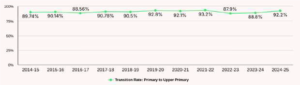
There is a consistent decline in transition rates as students advance through successive stages of schooling. While 88.8 per cent of students’ progress from primary to upper primary, the rate drops to 83.3 per cent at the secondary level, and further to 71.5 per cent at the higher secondary level, indicating increased attrition in later years. Notably, girls have higher transition rates than boys at both the primary to upper primary and secondary to higher secondary stages.
The transition rate from upper primary to secondary has declined from 91.58 per cent in 2014-15 to 86.6 per cent in 2024-25 indicating a weakening in progression at this stage. The national average, which had remained around 90-92 per cent for most of the decade, fell steadily after 2020-21, indicating growing challenges in retaining children beyond Grade 8. This pattern is also reflected in the stagnant GER at the secondary level, where only modest improvements have been recorded over the same period.
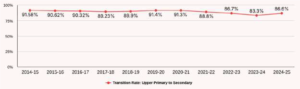
But the picture is not uniform throughout the country with a few states like Kerala, Puducherry, Lakshadweep, Chandigarh, Telangana, Maharashtra, Himachal Pradesh and Goa showing near universal transition from upper primary to secondary levels. Not surprisingly, Bihar, Madhya Pradesh, Uttar Pradesh and Jharkhand are among the laggards. The biggest surprise among the laggards were the northeastern states of Mizoram and Meghalaya, both of which have near universal literacy.
Decrease In Dropout Rates:
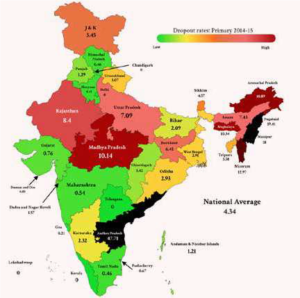
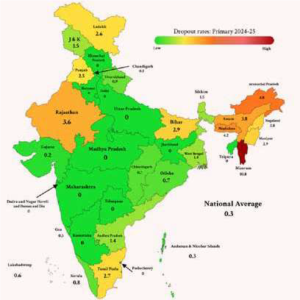
The education scenario is not all dark as the decrease in the dropout rate at the primary level showed. There has been a sharp drop in dropout rates from 4.34 per cent in 2014-15 to 0.3 per cent in 2024-25 after touching a peak of 7.8 per cent in 2022-23. Though 22 states and union territories reported near zero dropout rates, Mizoram with 10.8 per cent reported the highest. At the secondary level, though there has been a considerable drop from 2014-15, at 11.5 per cent, it is still the highest dropout rate in schools.
Student-Teacher Ratio:
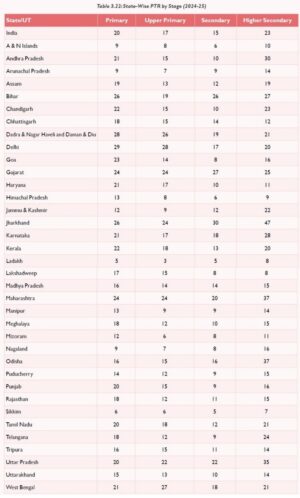
There are about 10 million teachers across India, and the student-teacher ratio is within acceptable limits specified in the RTE Act. There are outliers like Jharkhand (47) and Maharashtra (37). But there are large numbers of vacancies for teachers in states like Bihar, Madhya Pradesh and West Bengal. Bihar has more than two lakh vacancies at the elementary level and about 2.8 lakh vacancies overall, while West Bengal has about 70,000 vacancies. At the all-India level there is a 16 per cent shortage of teachers.
Government Schools on the Decline:
Yet despite these shortcomings government schools continue to remain the mainstay of the education system, though their share has declined over the decade, from 54.3 per cent in 2014-15 to 49.25 per cent in 2024-25. Government-aided schools account for about one-tenth of total enrolment, registering a slight reduction in their share during the same period. In contrast, private schools, while fewer in number, have expanded their enrolment share considerably from 31.7 per cent in 2014-15 to 38.8 per cent in 2024-25. The “Others” category, including Madrasas, unrecognised institutions, and alternative schools, continues to serve a small proportion of students, with their share declining marginally from 2.4 per cent to 1.9 per cent.
Budget on School Education:
Now, as far as the budget is concerned, the government budgeted Rs. 83,562 crores in the 2026-27 budget, up from Rs. 70,567 crores actually spent in the previous year on school education. The government had spent Rs. 65,159 crores in 2024-25 on school education. Between 2017-18 and 2024-25 the budget allocation showed a CAGR of 5 per cent. However, the Parliamentary Standing Committee on Education in its report in 2025, recommended an increase of 8-10 per cent to cover inflation. NEP 2020 had recommended a spending of 6 per cent of the GDP on education but it had touched only 4.1 per cent.
Conclusion: The Shrinking Foundations of Viksit Bharat
The consequences of our contracting education system are far-reaching. Every school that closes in a remote village, every student who leaves the classroom prematurely, and every examination compromised by administrative failure widens existing inequalities and weakens the promise of equal opportunity.
A nation aspiring to lead the 21st century cannot afford to have empty classrooms, while its ambitions grow.
India has set itself an ambitious goal: universal school education by 2030 as a cornerstone of its vision for Viksit Bharat @ 2047, the centenary of independence. Yet that aspiration will remain elusive unless policymakers confront the widening gap between rhetoric and reality. The challenge is no longer simply to expand access to education; it is to restore trust in the institutions that deliver it.