
 Dr. Bhashyam Kasturi

In the epic Ramayana, when Rama and Lakshamana are fighting Ravana and his brothers in Lanka, they come across the phenomenon of ‘Maya’ or the enemy using magic to disappear on the battlefield. This was the art of camouflage; today, the Indian armed forces have graduated to using stealth technology, helping soldiers remain hidden on the battlefield. That is just one part of the move towards incorporating high technology on the battlefield by the Indian Armed Forces
It was seen during ‘Operation Sindoor’, how advanced missiles with tracking and sensors hit their targets from miles away, either air launched, or land launched. Thus, both defensive and offensive systems are in vogue today, with bits and pieces of technology becoming standard tools in the inventory of the forces. These are not new developments and have been in the pipeline for some time. The induction of robotic dogs in the Indian Army, and which were on display during the Republic Day parade in 2026 is another such example.
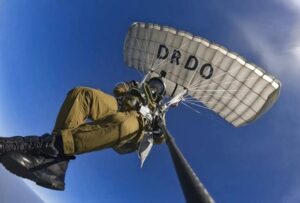
While the DRDO and private industry have been working together to bring out new technologies for the armed forces, the remarkable thing is the speed of this transition from design to development. For instance, in 2023, the Indian Army signed an MoU with Hyper Stealth Technologies Pvt. Ltd. for the Integrated Mobile Camouflage System (IMCS) for the Mechanised Forces. IMCS comprises of low emissivity and/or CAM-IIR coatings and mobile camouflage materials giving Armoured Fighting Vehicle (AFV) the ability to merge with a terrain background. The technology involves low emissivity coatings and camouflage material that provides significant capability enhancement in stealth, according to Press Information Bureau release on 14 March 2023.
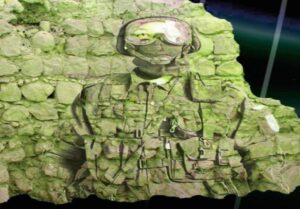
In a world where truth is stranger than fiction, quantum stealth technology has emerged as a transformative force in the realm of military innovation. Inspired by the concept of invisibility portrayed in many films and TV series, this cutting-edge technology is today no more a fantasy but has become a reality. According to a linkedIn post by Lt. Col C.K. Jena, on 19 August 2023, “Developed by the trailblazing Canadian company HyperStealth Biotechnology, Quantum Stealth harnesses the power of lenticular lenses to manipulate light waves, leading to a new era of stealth capabilities”.
Beyond large vehicles, the Indian armed forces are also showing interest in applying nano-tech stealth cloaks to smaller systems. In July 2025, Asian Military Review, reported that domestic firms, such as Veera Dynamics, are developing Project RAMA—a radar-absorption and multi-spectral adaptive material. This material wraps around frontline drones and unmanned systems, to allow them to conduct high-risk, completely covert surveillance behind hostile lines. The drone will use RAMA, a nanotech stealth coating that absorbs radar and infrared, adapts to heat, and hides drones in GPS- and RF-denied areas. This is a stealth drone concept tied to Veera Dynamics and Binford Labs’ RAMA coating. Pertinently, two Hyderabad-based firms are collaborating to build India’s first ‘dual stealth drone’, combining autonomous flight with a new material that hides platforms from both radar and infrared (IR) sensors, as reported by The Defense Post, on 23 July 2025.

At a simpler level, but of equal importance are the anti-microbial and anti-bug bedsheets designed by DRDO, that have been today passed on to industry for commercial manufacture and distribution. These bedsheets, made of a polyester-cotton mix, reduce microbial infections by 99% even after 20 washes! Developed by DRDO’s Defence Research Laboratory in Tezpur, Assam, these bedsheets cater to both the military and paramilitary forces. The nano-finished material is engineered to be anti-viral (effectively neutralizing viruses like the H1N1 Influenza A strain) and anti-fungal. These are small steps towards a tech-driven armed forces in India. Just how rapidly this transformation is occurring can be seen in the transfer of seven new technologies by DRDO in December 2025 for commercial production. According to Press Information Bureau release on 5 December 2025, each of these technologies/products have been designed, developed & extensively tested by the Indian Industry with close collaboration and guidance of DRDO domain experts & Tri-services, under the Technology Development Fund, reinforcing the scheme’s focus on import substitution and critical technology development.

With the objective of easing the load on human beings and pack animals in difficult terrain, the Indian Army has officially transitioned robotic dogs from the testing phase into active military service. Formally classified as MULEs (Multi-Utility Legged Equipment), these quadrupedal unmanned ground vehicles (Q-UGVs) are being deployed to the frontline—particularly in high-altitude border regions—to replace animal transport and protect human soldiers in hazardous zones as reported in AIM’s LinkedIn post.
Today, the advantage of collaboration with countries like France, the US, Israel and Japan is that they assist India in acquiring the latest technology, with transfer of technology, in several cases. This helps to cut the life cycle development of many systems and helps in giving India a cutting edge in areas that are crucial to our national security.