 Dr. Bhashyam Kasturi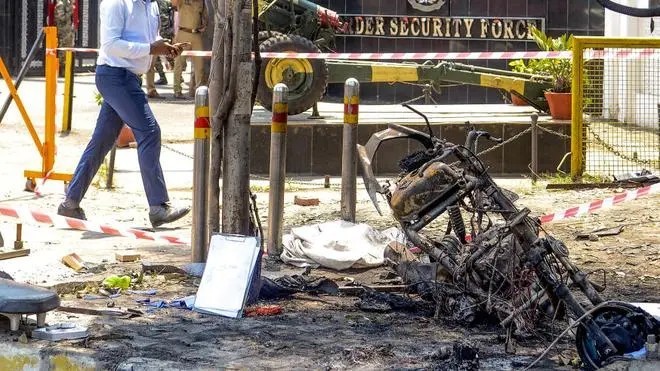
The Indian State of Punjab has witnessed sixteen low-intensity grenade and IED blasts between 2024 and 2025. The latest in the series being, the motorcycle borne attempted attack on the HQ of the BJP in Chandigarh in May 2026. Punjab Police has captured five of the attackers and claim that this was a Pak-ISI plan with handlers operating out of Germany and Portugal.
Weeks earlier to this attack, in a sharply worded and unusually provocative address, Pakistan’s Defence Minister, Khawaja Asif, issued an explicit warning to India, signalling that any future confrontation between the two nuclear-armed neighbours would not remain confined to traditional military boundaries. He suggested that Pakistan would be prepared to carry the conflict deep into Indian territory, including against civilian and ideological targets such as homes and RSS camps.
“You are talking about India, let it be known, God willing, that if they try again, God willing, they will suffer even more humiliation than before. And this time it will not be limited to 200–250 kilometres like before, the war will go deeper inside. Now we will strike inside homes, in the camps of RSS members”, said Pakistan’s Defence Minister, Khawaja Asif.
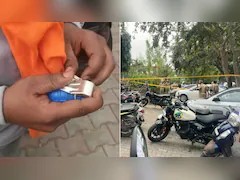
Also of note were the earlier twin blasts, one outside the BSF Frontier Headquarters in Jalandhar and another near the Khasa Military Camp in Amritsar, within a span of three hours. The low-intensity blast at the BJP HQ in Chandigarh on 1st April was carried out by two motorcycle borne men, with a hand grenade, probably of Chinese origin. The responsibility for the attack was later claimed by the Babbar Khalsa International (BKI).
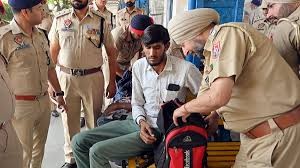
The attack on the BJP office was carried out by motor cycle borne terrorists who appeared to have also video recorded the act. Some reports suggest that a Chinese grenade was used in the attack, though the explosion only damaged a parked car and was more like a demonstration than an actual act of terror. The BKI in a social media post claimed the ‘attack’ was in retaliation for the killing of a youth Ranjit Singh in Gurdaspur. Earlier, at the end of March another grenade attack took place at Bhindi Saidan Police Station in Amritsar. This again was a low-intensity blast and by motorcycle borne attackers. It was the 10th such explosion at a police station since November 2024 indicating that future blasts will target police stations and with greater munitions. Two possibilities are there. One, that motorcycle borne attackers begin to target police officers of Punjab Police and second, they target individual police officers, much like what occurred in the 1980s. Pakistan is clearly back in the game and the opposition-ruled Punjab state under the Aam Aadmi Party is the target.
The low-intensity blasts have witnessed a variety of targets including police outposts, politicians, symbols of authority, religious sites and most lately, political offices. Notably, the Punjab Police has been very active in solving many of these cases and in the BJP office attack have arrested five people. The Pak-ISI hand has been made public and this is not surprising given their past support to Khalistani extremist groups. Thus, any inputs on coordination between the BKI and the ISI should be viewed seriously. The response of the State Police makes it amply clear that speedy solving of the attacks is a politically sensible thing to do, with the State elections round the corner next year. However, one can expect more attacks in the coming months. This is because Pakistan has found it difficult to operate in south Kashmir, where the Indian Army has managed to tighten the grid.
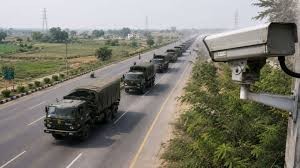
More recently, another bizarre incident has come to light of a businessman planting cameras on the highway with a view to possibly monitoring military movement. This intelligence gathering operation is of importance. Punjab Police thus, probably had a major breakthrough when they arrested Balbir Singh, a resident of Pathankot. Balbir is alleged to have installed a CCTV
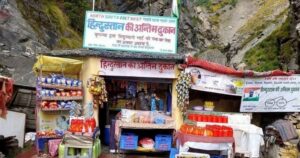
camera near a bridge on the Jammu-Pathankot stretch of NH-44. His handler was apparently based in Dubai. The worrisome fact is that Balbir confessed to have installed the camera in January, which indicates that footage recorded would have been transmitted already. Two similar cases were discovered by the Punjab Police last month, one in Jalandhar where the operative was using a Chinese-made CCTV, while the second case was a joint operation by the Kapurthala Police and IB, to bust a CCTV camera operation. Again, the Chinese angle comes into play. Of course, Chinese CCTV cameras are available off-the-shelf and online. The idea of using these to monitor military movements however, suggests that the ISI has a plan for Punjab. Apart from the de-stabilisation already underway with the widespread smuggling to drugs and arms, ISI wants to weaken the sinews of the power of the State in the run-up to the elections. The other goal is to know why and how Operation Sindoor is continuing. But why use amateur cameras when Pakistan gets imagery from Chinese satellites and COMINT & ELINT on Indian Army troop movements? It could be to obtain corroborative ground intelligence.
The location of the shop and the camera in the vicinity of Mamun Cantonment is significant as it is the largest Cantonment in Asia. It is located in Pathankot on the Jammu-Pathankot highway. That the area is thick with Indian forces is an understatement because there are at least 2-3 Division-sized formations in Pathankot and several Independent ones. Armoured Brigades in and around the area. Tracking the movement of the Army convoys will give the enemy capability of tracking the Indian Army’s supply chains and equipment movement across the region. This Jammu-Pathankot Highway is the one that terrorists used to infiltrate when they attacked Pathankot Airforce base in 2016. There must be a thorough investigation in the Jammu-Pathankot area to track down other individuals who are probably still operating quietly. There is a method to this madness and India needs to be well prepared.