 Dr. Bhashyam Kasturi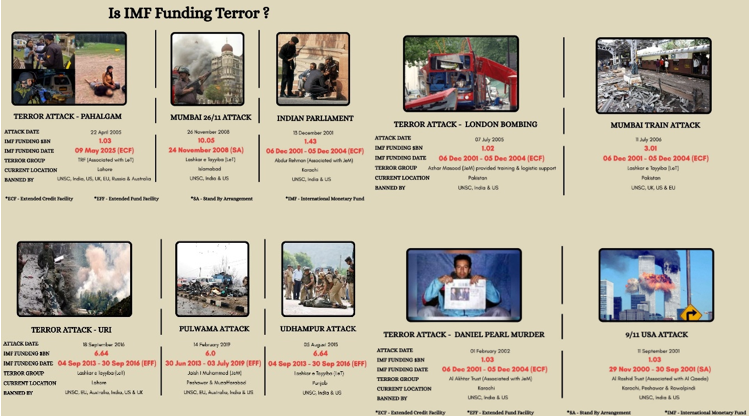
The International Monetary Fund (IMF) announced on 8 May 2026, that its board had cleared the way for Pakistan, to access about US$ 1.32 billion in fresh funding immediately. The IMF said, “Pakistan would be able to draw around US$ 1.1 billion under the Extended Fund Facility and about US$ 220 million under the Resilience and Sustainability Facility”, making the total disbursements available to Islamabad to about US$ 4.8 billion.
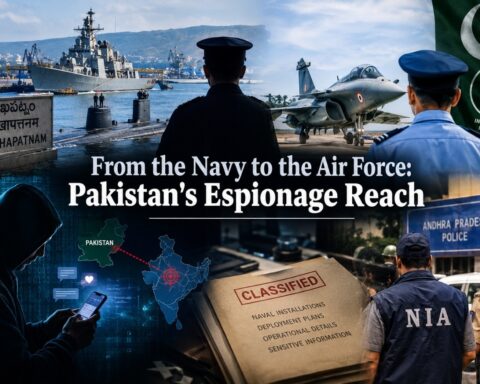
It is no coincidence, as money pours into Pakistan, it has begun preparations for an attack on India. In the first six months of this year, police have apprehended several operatives working in tandem with ISI handlers, with the objective of creating unrest in India.

Tatsat Chronicle in its article ‘Is IMF Funding Terror?’, dated May 24, 2025, has previously highlighted the recurring link between Pakistan’s IMF bailouts and the timing of terrorist attacks on Indian soil. Thus, with Islamabad launching a covert campaign and diplomatic blitzkrieg against India, it becomes obvious preparations for another strike are underway.
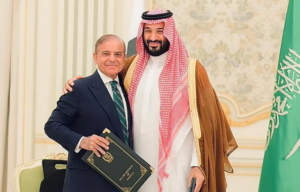
It is not only IMF which continues to give funds to Pakistan. Saudi Arabia just handed over US$ 3 billion in two tranches to Islamabad, in April this year. Additionally, the Saudi’s rolled over a US$ 5 billion loan to help stabilise Pakistan’s foreign exchange reserves. With Pakistan forging ahead on the diplomatic front, its leaders have begun making threats against India. This is the first time after Operation Sindoor, Islamabad has found its voice. Irrespective of whether these threats have any relevance, the fact remains that such rhetoric is backed by the ability to wage covert war against India using non-state actors.
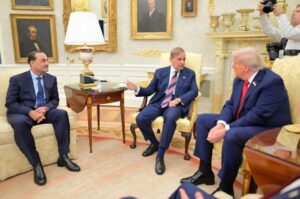
Recent developments come amidst intense diplomatic activity by Islamabad, primarily by a failed mediation between Iran and the US in the Gulf war. That the ceasefire agreement has little to do with Pakistan, is evident by the role played by Qatar and the UAE, but Pak PM Shahbaz Sharif and Army Chief General Asim Munir have managed to gain the spotlight.
At the same time, Pakistan appears to be undertaking a broader effort to reshape its image in Washington. In May, Islamabad signed a $1.2 million lobbying contract with a US-based firm, according to filings made under the US Foreign Agents Registration Act (FARA). The agreement, which took effect on 1st May, appoints Ervin Graves Strategy Group LLC., to advance Pakistan’s interests within US policymaking circles. Under the contract, the firm will engage members of Congress and their staff, particularly those serving on committees responsible for foreign affairs, defence, trade and appropriations. The FARA filings indicate that a central objective of the engagement is to present Pakistan as a dependable partner in counterterrorism and regional stability—a message aimed at reinforcing Islamabad’s standing in Washington, at a time of shifting geopolitical alignments.
Intelligence sources inform that Pakistan has been simultaneously planning to execute attacks on Indian soil, with the objective of creating communal unrest. Evidence of this comes from multiple sources, as arrests galore have occurred in the past two-three months. The arrest of a woman agent in Rajasthan, several ISI agents in Kerala and West Bengal indicate that something is afoot. These are illustrative examples of the larger ISI gameplan to destabilise India. The warning signs are there; it is now a question of not when but why, meaning will the future attack have a purpose?
ISI’s Digital Recruitment Drive Comes to India

The arrest on 22nd June, in Jaipur, of Babita Dhakad, with alleged links to the Jaish-e-Mohammed (JeM), by Rajasthan Police’s Anti-Terrorism Squad, is of grave concern. Reports indicate that she was radicalised online and planning to go to Pakistan to marry JeM Commander Abu Ubaidah. That Military Intelligence tipped off the ATS on Dhakad, indicating the possibility of a wider sleeper cell under creation by the ISI. The fact that contact with handlers in Pakistan was through social media indicates that Babita was one of several individuals contacted by the JeM in India. Investigations are underway to ascertain the possible larger network that the JeM is building in Rajasthan.

More recently, the Special Cell of the Delhi Police, on 2nd July, arrested four persons linked to Pakistan-based, Shahzad Bhatti. They were being trained for reconnaissance of religious places and places associated with the Delhi Police, in the capital. The aim was to carry out coordinated attacks and strikes in the capital. Of the four arrested, three were from Punjab, while the fourth was from Delhi. Foreign made pistols, cartridges and mobile phones were recovered during the operation.
Recently, on 7th July, the police arrested another six individuals on charges of plotting petrol bomb attacks in the capital. Interrogations reveal that the bomb attacks were planned on the directions of Pakistan-based alleged ISI handler Shahzad Bhatti. Who is Shahzad Bhatti? He is a well-known Pakistani social media influencer, who Indian agencies have identified as an ISI handler, working for the D-Company, who has created a digital network responsible for narcotics smuggling, weapons smuggling and is preparing sleeper cells to create unrest in India. Intelligence source speaking on the condition of anonymity say that Bhatti is one among several such public figures recruited by the ISI to create trouble in India.
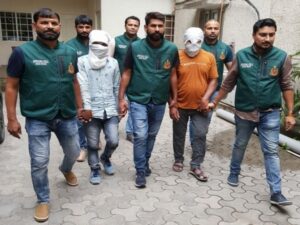
Earlier on 30th May, the Special Cell had arrested eight individuals who were associated with the Mumbai underworld and were plotting attacks across India. The arrests were made in Delhi, Maharashtra and Jharkhand. The government forces including the Railway Police and Mumbai Police were the reported targets. Pakistan-based handlers were mostly men from D-Company including Shahzad Bhatti, Yawar khan and Munna Jhingda.
Earlier, this June, police arrested seven persons associated with the terror-crime syndicates who were involved in illegal activities. In February 2026, eight people were arrested in Tamil Nadu and Delhi for plotting terror attacks in tandem with the ISI. Clearly, the ISI is having a busy season this year.
Pertinently, NIA has charged the LeT chief with having masterminded the Pahalgam attack in April last year. The recent arrests by Delhi Police Special Cell reveal increased coordination between Pakistan-based handlers and their operatives in India. This has been traced through phone calls, chats and other communication modes. The Red Fort blasts last year, just before the Bihar elections, indicate long-term preparations by the ISI to undertake sensational attacks on crowded places across India, including bus and railway stations. Just how deep is the ISI-Jihadi network in India, is evidenced by the supplementary charge sheet filed by the NIA, on 6th July 2026, directly naming Lashkar-e-Taiba (LeT) chief Hafeez Saeed, as the primary perpetrator in the Pahalgam attack last year. He has been charged both as an individual and as Chief of the LeT and its proxy, The Resistance Front. The ISI is thus clearly, working to find the means and wherewithal to attack India, under some pretext.
Who is weaponizing water now?
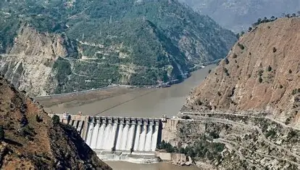
The other development of note on the Pakistan front is an attempt to weaponise water. By claiming that India is stopping the flow of water to Pakistan, under the Indus Waters Treaty (IWT) by violating international law and holding the Treaty in abeyance. This is complete hogwash. India has never claimed that it will stop the flow of water to Pakistan. Its position is that “blood and water cannot go hand in hand” and holds the position, that the IWT will be held in abeyance until Pakistan ceases acts of terrorism against India. Additionally, India is finding the means to better utilise its share of the waters apportioned to it under the IWT. This in no way tantamount to stoppage of water to Pakistan by India. However, Pakistan is an opportunist nation and is using this as an excuse to threaten India, literally.
Remarks made by Pakistan Army Chief Asim Munir, “We will wait for India to build a dam, and when it does so, we will destroy it with ten missiles”. Khawaja Asif, Defence Minister of Pakistan, said, “The moment we feel that our national security is under threat, and water is part of our national security, we will go to war”. The reference here obviously to India. It is not that this kind of lawfare has recently started, it began under the then Prime Minister Imran Khan regime. His National Security Adviser, Dr. Moeed Yusuf, began the lawfare campaign against India in the context of water and the IWT. The objective was to challenge everything that India did under the IWT and create obstacles for Indian projects. This is what India countered in the aftermath of Pakistan’s direct attack in Pahalgam, in April 2025.
PPP chairman Bilawal Bhutto has also accused India of weaponizing water with the aim of depriving Pakistan of water. Pakistan essentially accuses India of violating the treaty by diversion of river waters, by construction of dams and hydel projects on the Chenab and Jhelum rivers. On the contrary, India has kept Pakistan informed of all that it does under the provisions of the treaty, while Pakistan uses those very provisions to obstruct. For instance, Islamabad sought the World Bank to constitute an illegal Court of Arbitration to decide on the Ratle Hydropower Project on the Chenab and the Kishanganga Project.
Pakistan – a water scarce nation

Pakistan suffers water shortages not because of India, but because of its own inability to use water properly. Pakistan’s water availability per person is today less than 1,000 cubic metres, down from over 5,000 cubic metres in 1951. Pakistan’s two large dams, Karbala and Mangla are both heavy with silt and cannot supply long-term needs of the country. China is helping Pakistan with river projects on the Indus River and elsewhere. Inefficient water management is the bane of Pakistan’s water shortages as more than 60% of ground water gets wasted because, their canals are filled with silt and outdated.
Therefore, the recent verbal assault on India over water. Pakistan has recently also launched an international campaign over the treaty. The international IWT conference held in Islamabad on June 30, saw several Pakistani, Russian and Chinese speakers raise the rhetoric on the IWT. Many of the Pakistani speakers noted the violation of international law by India. Social media chose to carry excerpts of the speech made by Victor Gao, Vice President of Centre of China and Globalisation. He argued that blocking of Pakistan’s water was a violation of international law and urged the international community to ensure protection of the IWT. He also said that China could also do the same to India.
India can expect turbulence coming soon…
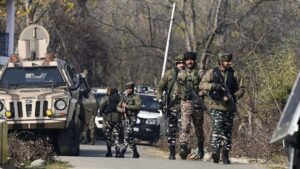
Pakistan is therefore, conducting a dual track policy towards India. One, is the covert campaign to create unrest in India, in states like Punjab, Maharashtra, Tamil Nadu and West Bengal. Second, public diplomacy is being used to promote the narrative that India is weaponizing water. Added to this a layer of the IMF and other countries providing funding to Pakistan. All this adds up to one potential possibility, i.e., a terrorist attack in India. Jammu and Kashmir is always a target, but choosing another target like an Indian dam would not be out of place.
Thus, India’s intelligence agencies must remain on high alert.