 Dr. Bhashyam Kasturi
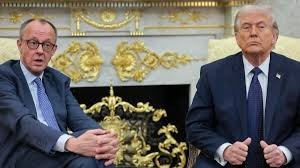
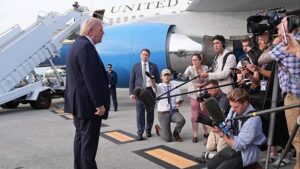
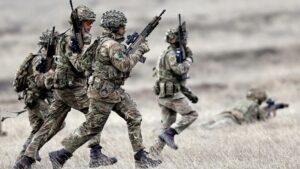
President Donald Trump’s decision on May 1 to withdraw 5,000 American troops from Germany is being interpreted in Europe less as a military adjustment than as a political reprimand. The move followed Chancellor Friedrich Merz’s sharp criticism of Washington’s conduct in the war with Iran, and it has underscored a widening trans-Atlantic unease over America’s strategic priorities and Europe’s dependence on them.
The withdrawal may seem symbolic and on paper, the reduction may appear modest. Nearly 31,000 American troops will remain stationed in Germany, preserving the backbone of the United States’ military footprint in Europe. But the more consequential signal lies elsewhere: Washington’s decision to defer the deployment of Tomahawk cruise missiles to German soil. That delay risks creating a deterrence gap at a moment when NATO allies remain deeply anxious about an emboldened Russia and the continuing war in Ukraine.
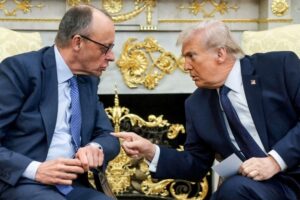
The remarks made by Chancellor Merz over the Iran war follow in the footsteps of Italy, the UK and Spain. Across Europe, governments including those of Italy, Britain and Spain have imposed varying restrictions on American military activity, on bases situated on their soil, reflecting growing discomfort with being drawn into conflicts over which they exercise little control. In that sense, Mr. Trump’s announcement appears less the outcome of a routine force posture review than a deliberate presidential rebuke aimed at Berlin. This is a small step with a big impact both psychologically and otherwise on Europe.
The symbolism matters. Europe has long relied on the assumption that American security guarantees, while occasionally strained, remained fundamentally unquestionable. By linking troop deployments and missile commitments to political disagreements with allies, Washington risks unsettling that assumption. Even limited withdrawals can carry outsized psychological consequences, particularly at a time when European capitals are already confronting doubts about NATO cohesion and America’s long-term reliability.
For Europe, the message is stark: strategic dependence comes with political vulnerability. And for NATO, the episode is another reminder that internal fractures, even more than Russian aggression, may pose the alliance’s greatest long-term challenge.
The US under Trump has been seeking a European-owned security architecture that relies less on US troops and missiles. With the latest move, Trump has signalled that a pivot to the Indo-Pacific and more importantly, to the Middle East is the objective. Trump’s move signals a new threat to NATO. For long, he has been asking Europe to fund its own security.
However, an actual moving away of American troops from European soil has a different connotation, with the UK and Spain refusing to host US aircraft on their Iran campaign. Chancellor Merz’s refusal to support the Iran war and stating that Iran had humiliated the US by closing the Strait of Hormuz has obviously irked the mercurial Trump. Both Spain and Italy had already refused to help Trump in his war with Iran and assist in the US blockade of the Strait of Hormuz, resultant in the US President threatening recently, to withdraw more US troops from Europe. Note that the scaling back has been written into the 2026 US Forces Posture Review by calling for a “Homeland-First” strategy, with the expectation that Europe can fund and equip its own security for conventional defence.
Clearly, the US does not see the same threat from Russia, as like Europe. This is despite the war in Ukraine. Therefore, more serious than the withdrawal of troops is the non-deployment of Tomahawk cruise missiles signalling the removal of deep-strike precision capability that Europe could potentially need in case of a conflict with Russia.
Two lessons stand out. French President Macron’s call for greater self- reliance in weapons manufacture for Europe and the need for greater collaborative efforts to manufacture highly advanced missiles, like for example the German -Swedish Taurus cruise missile.
Further, that NATO has asked for clarification from the US about the troop withdrawal means that European allies were not consulted before the decision was announced.
From a US defence industry perspective, there is a huge gap to be filled in the American inventory by the firing of over 850 Tomahawk missiles during the first few weeks of the Iran war. For a missile that costs close to US$ 2 million per piece, the US needs to find the money to first fill its own inventory, before deploying them to Europe. The bottom-line for the US currently is a downturn in the economy. An annual inflation rate of 3.8% has hit almost all sectors of the economy, including energy and food prices. This suggests that Washington will find it difficult to rapidly replenish defence losses caused by the war in Iran. Little wonder then that the Pentagon entered exploratory discussions in April 2026, with major US automotive companies to evaluate their excess capacity to boost military output. This focuses on expanding the defence industrial base to scale up the production of munitions, counter-drone systems, and military transport vehicles.
There is a vicious cycle at work which threatens European security. At one level, is an economy that is witnessing rising inflation, at another, is a defence establishment rapidly denuded of its critical munitions’ consequent to the war with Iran. More importantly, transactional Trump views the world through a bifocal lens, with Europe clearly on his wrong side. The challenge of self-reliance for Europe is therefore, even more real today. Negotiating these difficult times will see Europe’s attempt to use all its leverages to ensure NATO unity. Any weakening of NATO will only benefit President Putin in the long run.