 Dr. Bhashyam Kasturi
Iran war and profiteering
Two aspects of the Iran war are high crude prices and suspicious high-volume trades. Most recently, President Trump blamed major oil companies for raking up profits from the Iran war, mainly, Exxon Mobile and Chevron who have made major profits from the shortages in the oil market. But Trump forgets that his own family including Jared Kushner stand to benefit from the war in several ways. For instance, the 17th June peace deal, with Iran included a US$ 300 billion real estate investment fund, that would have American companies “Rebuild” an Iran destroyed by US bombs.
Another instance of this commercialisation of war has been, Trump’s sons selling drones to Gulf countries, through a firm called Powerus, affected by Iranian attacks. This is a part of the old defence industry complex, which always profited from war, but today is functioning in a more nuanced manner and clearly tilted in favour of the Trump family and its close associates.
Betting on Oil Futures
According to The Guardian, 23rd March 2026, one of the early deals on oil was made in March 2026, with eight accounts-all created around 21st March, betting on a ceasefire deal by 31st March. The bets were reportedly placed at US$ 70,000, and the anticipated profit on that was US$ 820,000. Similarly, 733 bets were placed on oil markets falling by 31 March, on a peace deal. This was at 6.49 EST, and a minute later it went up to over 2,000 bets. At 7.04 EST Trump announced a delay in the strikes. Thus, signalling a company between the US Government and certain firms to make profits. These are bets which can be placed on real world events, on something known as PolyMarket. Obviously, these are insiders who know or are told of Trump’s proposed actions to be able to bet safely.
This activity is reminiscent of the satta bazaar in India, where millions are traded for political and economic issues. The satta becomes really active during the time of elections and bets allow individuals to make a pile, if they bet on the right party or individual. Even here of course, insider information provides advance warning permitting placing of bets. A similar thing is happening in the US.
A BBC examination of trade volume data across financial markets in recent months, revealed a consistent pattern of spikes “just hours and sometimes minutes” before a US Presidential declaration on the Iran war, according to BBC News, 20th April 2026.
Several senators and representatives in Congress have written letters to government institutions seeking probes into this new-found love for the betting market. Senator Elizabeth Warren and Senator Sheldon Whitehouse have written to Michael S. Selig, Chairman of the Commodity Futures Trading Commission (CFTC), asking for an investigation into trading patterns in oil futures just before two announcements made by the Trump administration (US Senate Committee on Banking, Housing and Urban Affairs, 10 April 2026). The letter refers to two instances of such trading, the first on 23rd March and the second on 7th April 2026.
Similarly, Senators Mark Warner and Adam Schiff are already probing potential insider trading. They have sent a letter to the head of the Securities and Exchange Commission (SEC) and the Inspector General in the Defense Department. They cited public reporting of “large positions in equities and equity-linked derivatives” being built up before major policy announcements, such as the Iran war and President Donald Trump’s tariffs agenda.
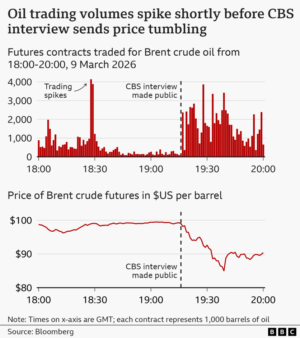 The lawmakers also cited a recent report that a broker tied to Defense Secretary Pete Hegseth sought to make a multimillion-dollar investment in a defense-linked Exchange Traded Fund weeks before the Iran war. The investment did not go through because the funds were not available with the broker. Pertinently, Senate investigators have given the CFTC and SEC with a timeline of high-volume trades that indicate advanced knowledge of Trump’s actions on Iran:
9 March 2026: This is the first incident wherein market data showed a massive spike in short oil contracts placed at 2:29 PM EST. Trump gave a CBS phone interview exactly 47 minutes later, saying the war was “very complete,” bringing down crude prices by 25% resulting in netting millions of dollars for anonymous shorts.
23 March 2026: This incident was linked to a sudden US$ 500 million to US$ 1.5 billion surge in S&P 500 e-Mini futures and crude oil contracts during thin premarket hours. Some 14 to 15 minutes later, Trump posted an unexpected message about “very good conversations” to end the war, causing oil prices to instantly drop and equities to rally.
7 April & 21 April 2026: Massive $950 million short positions are opened on oil hours before the administration officially announces structural temporary ceasefires. (Compiled from news reports on WION TV)
The chronology of suspected high-volume trades actually goes back to February 2026 (The Guardian, 18 April 2026) and since then several anonymous actors have made bets on oil futures. Reuters reports that the massive crude oil futures and S&P futures trades, no individual suspects have yet been named so far by any officials US institution, including the CFTC or SEC (Reuters, 16 April 2026). What regulators in the US are currently doing is to actively review “Tag 50” trader identification data requested from the CME Group and the Intercontinental Exchange to help identify the identities of those benefitting financially from these trades (NDTV/Bloomberg News, 16 April 2026).
Speculation about TNOS cryptocurrency
The speculation is that President Donald Trump will announce a deal with the company BlackRock in August 2026 to tokenize oil supply globally. This is to form the bedrock of a new “Transnational Oil Supply” mechanism based on cryptocurrency.
Whatever the truth about the speculations around the Trump-BlackRock intersection, the experience of insider trading in oil futures, highlights the risks of geo-political conflict and secret information that can make individuals rich overnight. This makes the current administration in the US far more risky in terms of linking conflict with profit and looking to use Iran as the scapegoat in this endeavour.