 Dr. Bhashyam Kasturi

The outburst by Starlink’s owner, Elon Musk, on social media against Mukesh Ambani, head of Reliance Industries, signals the end of a business romance that was inked last year. Both had agreed to work together to provide Starlink the entry point into India’s mobile business.
The terse questioning by Musk on who is really India’s Prime Minister, sends the signal that he is peeved at not being given access to India’s large and potential satellite broadband market. After all, Musk and Ambani had signed the much-touted agreement last year, to jointly help the former enter the Indian market in a specific segment. A year later the cookie has crumbled, and Mukesh Ambani announced a network of 1600 satellites, for his satellite broadband project, thus setting aside his ‘Musk’ collaboration.
Just how important the India market is for Musk becomes evident from the numbers involved; currently pegged by TRAI, at close to 1300 million subscribers. Starlink’s presence in Bangladesh and Sri Lanka are a drop in the Ocean.
Musk-Ambani differ over priorities
Elon Musk already has approval from the Indian government for operating a mobile network; he is however, still awaiting a clearance, to operate broadband services with low-orbit satellites.
Elon Musk is a mercurial businessman, having first teamed up with President Trump and then dumped him. The Indian magnate, Ambani is more astute and has been able to make things work to his advantage. The battle for India’s satellite broadband market thus just got hotter.
Musk and Ambani have become competitors from collaborators. While the MoU, signed March 12, 2025, is also there, but the clearance to Starlink from the government is an essential pre-requisite for operations to begin. Both have differences over the regulation, pricing and operation of the broadband market. Ambani prefers spectrum auction while Musk wants administrative approval. Elon Musk accuses Reliance of monopolistic tendencies and alleges that the latter is trying to protect its huge Indian subscriber base. Incidentally, Starlink also has a tie-up with Sunil Mittal of Airtel.
Basically, Elon Musk wants to capture the huge Indian market. He already has a presence in Sri Lanka and Bangladesh. The numbers there, of course, are miniscule compared to India. In Bangladesh, Starlink has 4,000 subscribers, having got its 10-year subscriber licence in April, last year. In October this year, Starlink became the first operator to provide Direct-to-Cell service in collaboration with Banglalink. A similar operation was started in Sri Lanka last year with fewer ground stations than Bangladesh.
Ambani changes his game plan

Reliance and Airtel hold around 39% and 38% of the mobile subscriber base in India, respectively. Ambani has a stronghold on the business and if his plans to get satellite broadband services in India activated, using SES medium orbit satellites works out, he is likely to have a much larger market share. For this Ambani has created a Joint Venture, ‘Reliance Jio Platform’, in which he holds a 51% stake while SES (headquartered in Luxemburg) holds 49%.
It is significant that Elon Musk intensified his criticism of Mukesh Ambani ahead of the scheduled IPO launch, of Reliance Jio Platforms on 21st October, with a valuation of Rs. 10 lakh crores. The game is, therefore, all about market share and Reliance obviously does not want Starlink to take over its subscriber base making it in real terms a monopoly. In July 2026, India’s space regulator, IN-SPACe, granted Jio the crucial technical assessment approval for the LEO design, proving its scientific viability.
| Starlink Vs Ambani: Current Status | |||
| Feature | Starlink (SpaceX) | Jio Space / Jio Satellite | Remarks |
| Technology | Low-Earth Orbit (LEO) Satellites | Medium & Low-Earth Orbit Satellites (Partnership with SES) | Starlink uses thousands of small satellites flying close to Earth. Jio partners with satellite operator ‘SES’, to use medium and low-altitude satellites. |
| Telecom License | Approved (GMPCS License) | Approved (JSCL / JSTL Licenses) | Both companies have obtained official telecom licenses from the Indian government to offer satellite services. |
| Security Clearance | Pending final checks | Pending final checks | Neither company can launch yet. Both are sitting in the same line, waiting for final government security checks. |
| Spectrum Allotment | Pending government assignment | Pending government assignment | Neither company has been assigned radio frequencies (spectrum) by the government to begin sending signals. |
| Source: www.indmoney.com | |||
Ambani has announced a ‘Sovereign Satellite Connectivity’ meaning thereby, that every aspect of this programme will be based in India, from the design, engineering, testing, integration, satellite launch, and terminal deployment. Everything will be 100% Indian, so as to insulate the project from global political interference or foreign security blocks.
Starlink and the National Security Question
The debate over Starlink’s entry into India has acquired a sharper national-security dimension. On October 13, the Swadeshi Jagran Manch (SJM), the economic wing of the Rashtriya Swayamsevak Sangh (RSS), urged the government to block Elon Musk’s satellite internet service from launching in India. According to Reuters, the organisation argued that Starlink’s technology could limit the authorities’ ability to suspend internet services during emergencies and make it more difficult to ensure that Indian internet traffic remains on domestic infrastructure.
Also, a report by Takshashila Foundation raised red flags, by pointing to how Elon Musk unilaterally restricted Starlink connectivity during active military operations in Ukraine. The report also shows how smuggled hardware was used to bypass state blocks in Iran. That is part of the reason for India’s caution about Starlink as such private infrastructure could be turned off or influenced by a foreign government during a crisis. Additionally, India would like guarantees that it would have the final say over switching off broadband provided by Starlink, particularly during internal security operations or high-risk situations, which demand internet shutdowns.
Has Starlink Operated in India Despite Restrictions?
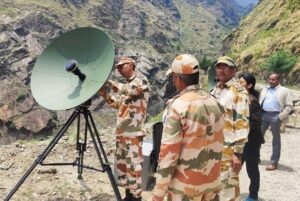
India is concerned because Starlink equipment was captured during anti-insurgent operations in Manipur. Security Forces have also found unauthorised versions, in the Andaman Sea and the Punjab border complicating matters. The concern is that this black-market acquired equipment could be used by terrorists and smugglers. This obviously remains a key concern for national security planners.
The discovery of Starlink equipment in India has raised questions about whether its services can be accessed despite the absence of regulatory approval. In December 2024, security forces recovered a Starlink dish and router from a militant camp in Manipur. Elon Musk subsequently stated that Starlink’s satellite beams were switched off over India. However, The Guardian, citing security officials and other sources, reported in January 2025, that the devices had worked in some parts of Manipur, particularly near the Myanmar border.
A separate incident raised concerns about the use of satellite communications in maritime crime. In November 2024, Andaman and Nicobar Islands Police seized a vessel carrying more than six tonnes of methamphetamine, with an estimated retail value of approximately $4.25 billion. Investigators reported that a Starlink Mini device had been used during the operation, including for navigation. According to reporting cited by The Economic Times and the Takshashila Institution’s subsequent assessment, Starlink declined Indian authorities’ request for information about the device’s users, citing data-privacy considerations and directing authorities towards formal legal channels.
Taken together, these incidents raise a broader question for Indian policymakers: how effectively can the government enforce its laws, investigate illicit activity and exercise control over connectivity, when satellite equipment can be brought into the country without authorisation?
To break the current deadlock over security concerns, Lauren Dreyer, Starlink’s Vice President of Business Operations, at the India Mobile Congress 2026, went to the extent of stating, that the company had implemented India-specific infrastructure, including the construction of twenty dedicated gateway sites.
Lawful Interception of communications
From an intelligence perspective, it is imperative that the government can conduct “lawful interception” of all kinds of communication, especially while monitoring and tracking terrorist and insurgent organizations. Starlink is a US company and governed by American laws, thus making it less liable to be responsible, when it comes to issues relating to India’s national security.
At the same time, current Indian regulations do not allow any user traffic originating from India to be routed, mirrored, or decrypted through a server or gateway located outside India. Zero cross-border leakage of metadata or active communication feeds is an essential requirement for most intelligence agencies.
Way Ahead
Ultimately, the Starlink–Ambani confrontation is about more than a commercial falling-out between two powerful business leaders; it raises fundamental questions about who controls India’s digital future. So much for the Ambani-Musk pact and the much-publicised Musk meeting with Prime Minister Narendra Modi!
There are thus several factors at play and India must have a robust ecosystem ready to receive Starlink, if at all the government decides to accord the necessary security approvals.
National Security is of course a priority, but a clear data perspective is required in every field of activity, prior to according approval, including health, commerce and communications. The bottom line from a simple business point of view is that Starlink is attempting to gain monopoly over the satellite broadband service at the cost of local companies in India. A similar situation has become evident in the US where very recently, a massive spectrum acquisition by SpaceX for the Starlink Mobile service triggered a historic single-day selloff for major American telecommunications companies. SpaceX’s purchase of low-band spectrum licences from another firm, Grain Management, reportedly triggered a 13% drop in the price of shares of major telecom firms like Verizon and AT&T. That should ring alarm bells in India.
Satellite broadband could transform connectivity across remote and underserved regions, but the promise of technology cannot come at the expense of national security, regulatory autonomy or a competitive domestic market.
India must neither shut the door to global innovation nor allow strategic communications infrastructure to become dependent on the decisions of a foreign corporation. Ideally, India should welcome foreign satellite services without allowing essential communications to depend on one foreign operator. The government’s task is to establish clear rules on spectrum allocation, pricing, lawful interception and operational control, applied consistently to domestic and foreign operators alike.
For Musk, access to India’s vast market must be earned through compliance and trust, not pressure played out on social media. For Ambani, the challenge is to demonstrate that a sovereign connectivity model can deliver on its promise. Ultimately, the winner should not be either billionaire, but the Indian consumer—and a country determined to retain control over its own digital destiny.